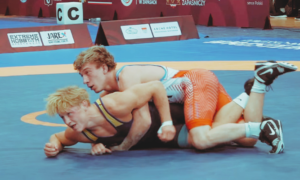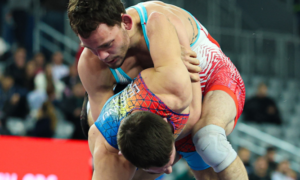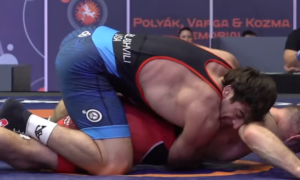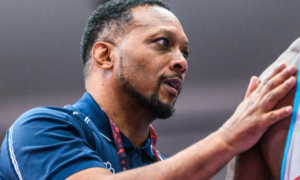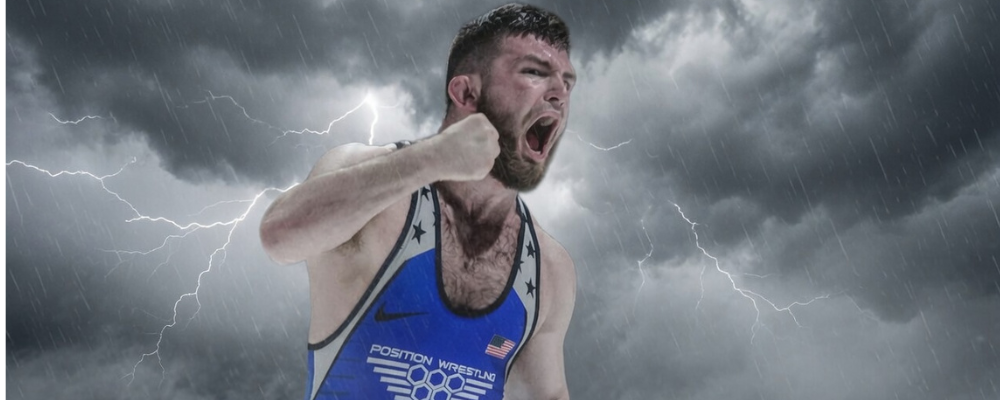
It’s as if Brett Back (72 kg, Position) belongs to another era. You hear him speak and have to remind yourself of his age. Sure, Back’s physical appearance is a bit misleading, too. Homeboy has looked like he’s on the tail-end of his 20’s for a few years already. He’s not. But it is when Back opens his mouth that you begin to realize that he is kind of different compared to the majority of his contemporaries.

Blending vivid articulation with cutting confidence, Back explains and describes matters of his wrestling career in much the same detailed manner to which one adheres when laying out their thesis. The difference is that Back tends to skip the sort of pretentious pedantry which accompanies most academic literary pursuits and instead pounds his points home in earnest so that everything he says is bereft of ambiguity. When the young man is finished speaking, you are not confused. You’re impressed.
Of course, at 20 years of age, Back does indeed qualify as an adult, certainly in the eyes of state and federal law. It is just that he is not your regular 20-year-old. Most in his age-range these days are woefully immature, entitled, shun accountability, and are equally obsessed with social media and themselves. When they open their mouths, the words might be correct but the substance is lacking. They think they know things, but do not. They feign resilience but hide from adversity. Compared to this generalized collective, Back is an oddity. He expresses conviction in the areas with which he is most accustomed, is curious when confronted with new ideas, and comfortably goes back-and-forth with you on your wavelength. It is not about friendliness. Friendliness can be faked. It instead comes down to security. Back is secure in his love for wrestling, his knowledge of the sport, and the fact that he is really, really good at it. So, when presented with an opportunity to discuss this whole endeavor, he is totally at ease, rattling off answers warmly and confidently as if there is little else that he’d rather be doing. His in-the-pocket grip on communication is a hallmark of maturity, and maturity for athletes of his level is mandatory if this walk of life is going to be worth their time.

And the reason why this is worth spotlighting is because for an American Greco-Roman athlete to succeed internationally, he must be mature enough to understand how treacherous is the landscape and remain devoted enough to climb it. And there is really only one way to approach the objective: by believing it is achievable in the first place. Sadly, not every young upstart in wrestling’s eco-system does. But again, Back is not like them. Not like most of them, at least.
Beginning in childhood, Back had Dennis Hall’s persistently-agitated voice blaring in his ears, with the latter regularly insisting to the former just how skilled and ruthless the “foreigners” are in the wrestling style they both adore. There might have been situations in which Hall regaled Back with war stories from days gone by, but mainly it was all about comprehending how Greco-Roman wrestling is to be trained and competed if eventual World-level success is to be thought of as attainable, for it is an exceedingly-high cost victory demands. So, no rose-colored glasses for Back. From a young age, he embraced the ethos which declares that this style is for hard men willing to do hard things harder than everyone else. It is only through the acceptance of this paradigm why a wrestler such as Back is able to believe that reaching such rarified air is not a fool’s errand. It centers around a simple concept, however. All Back has to do with his God-given ability is work as diligently and smartly as he possibly can, and keep the faith along the entire journey. That part he has down.
Now outsiders are learning his deal, too. Though Back did make a little noise a couple of years ago by winning the U20 Nationals, it is what he has done lately why more folks are taking notice. In April, Back took a major step in his career by placing 3rd at the Senior World Team Trials in Las Vegas. The performance — which saw him record several significant victories in his bracket — granted him status as a US National Team member for the first time. More importantly, especially to him, it also meant a spot on the USA U23 World Team. A place on a World roster is a first-time experience for him, as well. In addition, he is in a new location. Back had originally followed Hall to the University of Dubuque where he was, for a time, a dual-style wrestler, and it was for that school’s regional training center he had made his mark. But in late-25, Back committed to join Sam Hazewinkel’s Position Wrestling team in Oklahoma, and in doing so became one of the outfit’s inaugural members.
Molded by Hall and now coached by Hazewinkel — plus surrounded by high-level domestic training partners — Back’s development continues to improve at a rapid pace. There is more work to do. There always will be. But he knows what that work involves and where it can lead so long as he is willing to do it. This is how a man is supposed to operate. Even a young man, but a man nonetheless.
5PM Interview with Brett Back
5PM: What was your initial introduction to Greco?
Brett Back: It started with Dennis Hall, obviously. When I was little, his club (World Gold Wrestling) would have “upper body” nights on Thursdays. They would have the regular folkstyle and freestyle practices on Sunday and Tuesday, but Thursday night was for upper-body. He introduced me to Greco. I don’t remember this, but my dad says that I hated it. I apparently hated doing upper-body stuff because I just couldn’t understand it and figure it out. But, more and more, I started to. And, after a while, I started having some good results. It was just fun to me and I stuck with it, and it got me to this point.
5PM: At what age did you start thinking that this might be worth exploring more instead of sticking with regular folkstyle?
BB: It was really while the COVID stuff was happening. When that hit, everyone was inside all of the time. I mean, I would go to the Koontz’s house. We would sneak in over there. Hall, Dylan, Brady, and I would be in the basement of their house wrestling Greco for hours on end. I guess at that point I was just thinking, Man, this is something that I could pursue full-time, and I had wanted to since I was little. Ever since I understood what the Olympics was, I felt like Greco was the way that I could do that. And I thought it was fun. When I was little in that basement and getting my butt kicked, I still enjoyed it and came back everyday.
5PM: I know that you stopped competing folkstyle-wise in your sophomore year of high school, but did you mix a lot of Greco concepts in with folkstyle before that?
BB: Oh, yeah. All the time. It was always a hand-fight. That’s what Hall taught me in the beginning, that it is always a hand-fight. Always a two-on-one, always snap-downs to go-behinds. It would have been rare for you to see me shoot in a match. I just beat the dog tar out of ’em in the hand-fight and that was that.
5PM: Because you were good, you didn’t have coaches steer you towards attacking the legs more or anything like that?
BB: You know, I kind of march to the beat of my own drum, especially in high school. I didn’t really pay attention to what they had to say. That sounds arrogant, but what I mean by it is that I knew that I could be successful wrestling how I preferred, so why would I want to stop doing it?
5PM: In the span of a few years you went from Greco being something you might be interested in long-term to winning the U20 Nationals (in ’24) and were in the driver’s seat at the U20 Trials after that. Then you hit a detour. I’m sure that you must have been very disappointed to lose to Patrick Brackett in that Trials final.
Brett Back: I remember after that I was devastated. A month before that I had gotten hurt playing some soccer inside before practice. I knew that it was going to be tough to win no matter who I had. But I do remember being devastated afterwards.
5PM: But you regrouped and Dennis by then had already planted his flag at Dubuque, where for a time you doubled-up by wrestling folkstyle for the men’s team and Greco for the RTC. What were the positives to doing that, and what were the negatives if there were any?
BB: Hall sat me down and said that I could do both, and be successful at both. You know, having him as a youth coach growing up, I trusted him on that. So it was, Okay, let’s see if I can actually deal with wrestling Greco and folkstyle at the same time. Obviously, having the Greco background made wrestling folkstyle super-easy. I mean, I was a monster with my two-on-one against everybody. If you go back and watch my film, I of course was not the slickest folkstyle wrestler. I didn’t have the greatest leg attacks, and I was not the best at top and bottom. But on the feet, I would just hand-fight these guys to death. On their heads, two-on-ones… Maybe every now and then I would take a shot, but I think I benefited from it. Looking at it the other way, the pacing and pressure of folkstyle also benefited my Greco. But ultimately, it was a tough decision to be elite in both, so I decided to go full-time Greco.
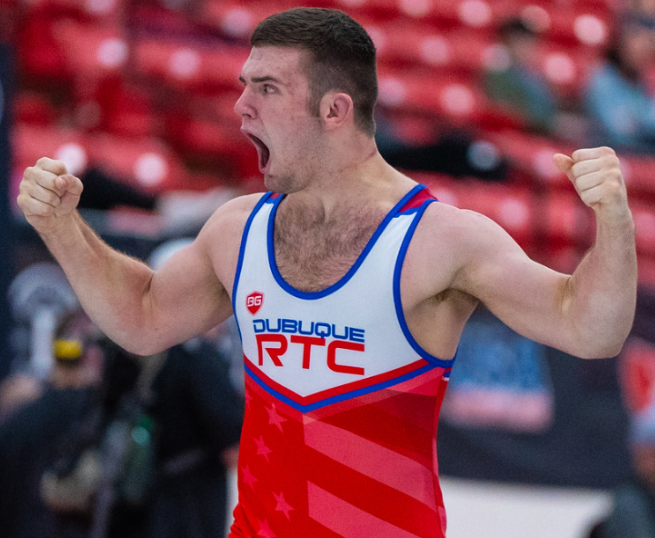
Back after prevailing in the semifinal round at the 2024 U20 Nationals. (Photo: Richard Immel)
5PM: You have friends who wrestle collegiately, or have done so, and had Greco aspirations. What do you tell friends who might want to come over to Greco and are in your age range? What are those conversations like when you consider the burden of difficulty?
BB: Well, Jace Koelzer is a special case because he has always wanted to do Greco, too. He just didn’t have the opportunities, and obviously being part of a college team they were very limited. But if you have the opportunity to do it, and you want to, you have to jump in and attack it. You only have so much time to compete. Some people are lucky to make into their 30’s and still compete. If you’re only spending four or five years training Greco full-time… I mean, you have to get ahead of it earlier. I don’t like it that guys are waiting so long to make this decision. You are either going to be all-in or you’re not. It’s like winning. You are either going to win or you’re not. Your effort determines that.
5PM: My observation is that we have passed the point in this country, from a developmental aspect, where someone can wrestle folkstyle in college for four or five years, switch to full-time Greco post-graduation, and still one day become a Greco World medalist. Maybe in the upper-weights it can happen, but that’s it. There might be exceptions, but that is why they are exceptions. It seems arrogant to me to think otherwise, that a guy can become a Greco hobbyist for four to five years while all of the wrestlers from every other country are continuing to train, develop, and compete at increasingly higher levels, and yet an American might still expect to reach those types of levels despite having limited time on target by comparison. Agree or disagree?
BB: I agree, and I don’t. Sometimes winners just win, man. Hazewinkel kind of exemplifies that. Wherever he went, he won. Now I’m not saying that it can or cannot be done anymore, but now it is so serious — especially on the freestyle scene. I mean, there are 17-year-olds beating Senior World Team reps. We need that in Greco, too. We need guys to step up, take control of their journey, and find a way to win. And that doesn’t happen by going half-in and half-out like you’re talking about. We need guys who are dedicated to what they are doing. Now, that doesn’t mean we can’t have guys who do both and become successful. But we do need that guy who says, I want to be the best in the world and I’m going to do whatever it takes in this style only, and then lead the way.
5PM: It has to be an uncommon individual. But we can’t build our program around that system any longer.
BB: Wrestling is always evolving. Even from the time that I started competing to now, it’s a different sport. And from now until the time that I stop competing, it might be a completely different sport. We have to find a way to win now. Wrestling is getting better by the day. Are you going to make the changes necessary? Or are you going to fall into the past with everyone else?
5PM: What drew you to Sam Hazewinkel and Oklahoma? What was the origin story to your eventually winding up at Position?
Brett Back: Oh man, I have a crazy story about the whole thing. I knew that my time at Dubuque was coming to an end. Things weren’t working out. There was constant headbutting and differences in opinion. I was looking for a new home. It was Dennis who actually first told me about Position, and Brady Koontz had obviously been reaching out and had taken a spot there. I had a little info on what it was about but I wasn’t sold on it yet. So, I reached out to Northern Michigan, I talked to Jason Christenson at Doane a little bit, and talked to Joe Warren, who had just recently accepted a position at the OTC (Olympic Training Center). All of them were interested in having me come out to their facilities and look at their offers. I had honestly put Position on the back burner because after I had initially reached out, I had not heard back in a little bit. So I was just like, Man, I don’t need those guys, I can figure it out.
But the day I decided I was going to do something, I reached out to one of the guys here and said, Hey, I’m interested in coming out here to train full-time, text me back when you can. I then received a text while I was in class at the University of Dubuque. I was like, That must be the coach. Okay, wow, that was fast. And it was Sam Hazewinkel. He texted me, “Are you ready to commit to Position Wrestling? Let’s talk later tonight.” I about jumped up in the air. I was thinking, Oh gosh, this is serious now. But I hadn’t gotten my hopes up yet. Then later that night, he told me that I would be a full-time athlete there, that I would be paid to do what I love, have a great partner, and have a great training system. It all made sense, so that night I told him, “Okay, I’m on-board. I’m ready to win.” That’s how I came to Position.
5PM: Was it just excitement or was there any part of you that was a little apprehensive?
BB: At first, I was a little nervous and wasn’t ready to just jump on it. But having a good partner and a good training system I knew would be fundamental. I mean, you could have thrown a lot of money in my face and I probably would have said “no” if it meant that I would be wrestling 55-kilo guys all day because I knew that wasn’t what I needed. I needed someone who was going to push me to my limit, beat me up, break me down, and build me back up again. When they told me that my partner was going to be Benji Peak, I was like, Okay, this is the guy that I need to train with, this is the situation that I need to be in, and I’m ready for it.
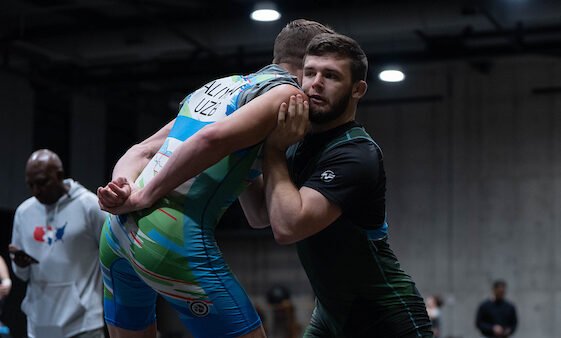
Multi-time World Team member Benji Peak (left) was a major reason why Back decided to move to Oklahoma and join Position Wrestling. (Photo: USA Wrestling)
5PM: Was there any kind of adjustment to moving to Oklahoma?
BB: I had moved before on my own already by living in Dubuque, but I would say that the worst thing about it was the just dang heat. It’s so hot out here sometimes. I’m sweating out here before practice even starts. I’m out there on the mat before practice with my shirt off because, if I have it on, I’ll sweat through it. I just can’t stand the heat sometimes.
5PM: Is it quiet out there?
BB: I’m right in between OKC (Oklahoma City) and Edmond, so there are about 600,000 people south of me and 90,000 north. I would not say so where I’m located. Right where the facility is located is on the outskirts of Edmond, in the back country a little bit. There is a bunch of industrial buildings. I’d say that it is pretty relaxed. There is not a lot of traffic. Getting there is pretty easy.
5PM: How has the team gelled since it has become a functional unit over the past six months?
BB: I like the way it looks and I like the way it feels. Every day that you walk into the room, it feels like you are at an actual competition. We want to make it as realistic as possible. When we are hitting our peaks, we are constantly doing matches. We give the most realistic feel that we can, just as we would in competition. I think having three full-sized competition mats really amplifies that to the next level. We also have two saunas, a cold tub, and full, functioning weight room. It is just a good situation to be in.
5PM: You guys just got done preparing for the Trials a couple of months ago and now we are in June. Give a sample of what a typical practice day looks like.
Brett Back: It depends on what day of the week. During the morning on Mondays, Wednesdays, and Fridays, we are doing lifts. All of the afternoons except for Wednesday, which is an off day, are regular training. But the training is based on what is coming up, what we are training for. Sam is really good at mapping out and planning our practices according to when we need to raise the intensity and when to take it easy. For example, right now we are starting our six-week cycle to prep the guys who are going to the “Ranking Series” tournament in Hungary (in July). This week will be a little more intense, and then next week and the week after are usually our hard weeks, which during these next two weeks we will be at camp in Colorado Springs. So, that should take care of that. Once we get home, it will be medium intensity as we sharpen our technique; then the week after that will be the final prep for the tournament.
5PM: Do you guys do all of your conditioning together or individually?
BB: I would say that we do it together. It depends on what our guys need. I may need something different than Benji or Brady Koontz. Especially me, because I’m kind of the younger guy in the group, I would say, so these older guys may not recover as well if we go for that little extra oomph as I would. I will sometimes do a little bit extra at the end to try to gain ground, especially with being the young guy in the room. I’m always trying to prove myself. Even though I know that I’m right there with the rest of the guys, I am still trying to earn my respect and be the best athlete that I can be for the guys.
5PM: You know, I say this to athletes and it’s “Oh, it didn’t go as planned”, but you did have a very impressive Senior Trials performance. Would you not agree at the very least that it was a solid, encouraging day in Vegas?
BB: Oh, I would totally agree. Obviously, being an athlete, there is always stuff I feel that I can improve on. I would say that I’m frustrated with the areas I didn’t do so good, but I’m still happy with how I did overall. I think it’s a good benchmark for now.
5PM: You won a couple of matches dominantly and then you went against a good friend of mine, the top seed, Alex Sancho. We’re talking about a marquee opponent who is a multi-time World Team member and Olympian. A dude who has been at or near the top for over a decade. A guy who threw Artem Surkov for four points in the Olympics. What is your mentality going into a match like that one?
BB: Well, I think the best guy in the entire tournament that I knew I was going to have was my training partner, so…
5PM: See, what a great answer. It’s like you take classes. Keep going.
BB: It’s easy to believe that you are going to beat him (Sancho) when you know that you are competitive with your teammate. Especially with watching his (Sancho’s) first match. I think everyone on my team came up to me and said, You are going to beat this guy today. And with Koelzer beating his #1 seed in the quarters (Max Black), it gave me confidence to believe that, Hey, this is doable and I’m going to go do it. It wasn’t an exciting, high-flying match, but it was my match from start to finish and I made sure of it. I wanted to control every single position and dominate, and I did that. I did my job.
5PM: When he’s on, Alex is probably the best in the country from top par terre and I’ll say that for Benji, also. That could have been an x-factor in this match and I’m assuming you knew that.
BB: I knew that I could get the first passivity just from watching his first match. I knew that if I just put enough pressure on him that he would be exhausted by the time he got on top of me. That’s what made the difference. I really wanted to make sure that he was having trouble breathing when he was on top of me because I knew that I could defend when he’s tired.
5PM: Hall says that is the secret to beating foreigners, but we move on to the semifinal. From a spectator standpoint, it was a thrilling match. Peyton Robb is a beast, an excellent competitor. It was a tough, tough match. But ultimately, it was a heartbreaker for you. What did Hazewinkel say to you after this match?
BB: He didn’t have any time to talk to me because Benji was right after me. He kind of came over to the side and said, “You’re going to come back and you’re going to get 3rd.” Then he went to the mat to help Benji. I sat there and watched Benji win his semifinal. It was such a quick turnaround. I remember watching Benji finish his match and then changing singlets because I knew I was a different color in my next match, and then literally walking straight back into the arena because I was on-deck. If the match before me didn’t have a 15-minute time limit, I would have probably been on the mat after my semifinal within 25 minutes.
I knew what I needed to do. I knew that I was going to get 3rd in that tournament. There was no way that I wasn’t going to come back and get 3rd in my mind. I’ve always been like that. If you’re going to lose, you have to get 3rd, right? I hate it that the loss happened. I feel like I was the better wrestler, but I am also going to give Peyton his flowers because he wrestled me to the best of his ability and he beat me. But I knew after that I was going to get 3rd and I wasn’t going to let anything stop me.
5PM: And you beat a fellow terrific young wrestler for 3rd, Aliaksandr Kikiniou Jr., who was a Trials finalist last year. If you want to talk technical, he is pretty technical.
Brett Back: I would say so. He definitely has that arm throw down. We had scouted him and knew that he has that arm throw. I started out looking for it and then he kind of lulls you to sleep. I remember thinking during the match, Man, he hasn’t gotten close to this once. I wonder what happens if I actually punch this underhook… And then he scored two on me (laughs). So I was like, Okay, I’m down 2-1 and now I have to go get it. But that’s another thing: I knew that I could go get it when it mattered. I knew that just because I was down by a point, I wasn’t going to get another chance on top in the second period. I knew that if I just pulled the trigger and put the hammer down that I was going to go find something. And I ended up doing it.
5PM: You made National Team at this tournament. I imagine as a young wrestler that you knew what you did here.
BB: I knew what I did once it happened, but in the moment I didn’t care. I was just happy to win. I was happier that I made the U23 World Team. I didn’t care about the National Team, or the stipend, or the title of that. I was just happy to make the U23 World Team. I had been in the running before for Cadet and Junior World Teams, and all different sorts of stuff, and have come up a point short or with the heartbreak like with losing to Pat in the best-of-three two years prior. I could never quite break through. I tried different weight classes, I tried many different things and couldn’t quite get it. So with knowing that I had finally made a World Team, I was so happy. I was so happy.
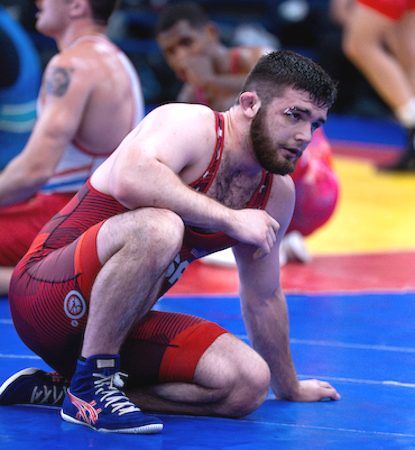
Back at the recent National Team camp at the Olympic and Paralympic Training Center in Colorado Springs. (Photo: Ava Fricke/USA Wrestling)
5PM: Right, and so what it means is that you are currently in the World Championships training cycle. What has this process entailed so far?
BB: It has been kind of hectic since we got back in trying to see what that might look like. The hard work is easy. Not really, but you know. Knowing when to work hard is the hard part. Doing the actual work is easier, because we have been spending the past month trying to figure out dates for when we’re going overseas, what dates we are going to compete, what to expect, what we want to work on as we prepare for the World Championships, and how to keep my body healthy and in the best shape of my life — and we’re doing this all at the same time. It is a lot to balance.
5PM: Is this all charted out for you by Sam? Or is it as you go along here that stuff is added and adjustments are made? I mean, is there like a giant white board in the wrestling room for all you guys?
BB: There actually is a giant whiteboard in there for all of us with all of the dates we are going to Europe and a schedule that is a broad overview. And then Sam himself has six-week cycles on his own little whiteboard.
5PM: How do you view your progress thus far over the past six months since going out to Oklahoma? How has being part of this team informed and influenced your perspective on training, what your needs are, and how you are developing?
Brett Back: I think that it has opened my eyes to different training styles. I really only had one training style from being with Coach Hall, which I am extremely grateful for. But being able to branch out and see a different way of doing things, and still being successful? I guess I could say that I’m happy but not satisfied yet. I’m not going to be satisfied until I have that World Championship, Olympic gold, or Olympic medal around my neck. I guess that I carry that into each practice. I know that this is not the end of the road, so I have to keep working hard until I accomplish my dreams.

SUBSCRIBE TO THE FIVE POINT MOVE PODCAST
iTunes | Stitcher | Spreaker | Google Play Music