Greco-Roman at the 2026 U20 World Championships begins on August 16 in Bratislava, Slovakia and the United States is bringing a very promising lineup to the event. Most of the roster has prior World-caliber experience; and those who might be lacking in that department are nonetheless seen as equally viable. As a group, their technical know-how and approaches to tactics are on the same wavelength as other U20 contingents from the recent past — which is a good thing. From top to bottom, the ’26 squad is formidable, each according to his own strengths. These are reasons why the majority of the American Greco community is excited for when this event kicks off in just a couple of weeks.

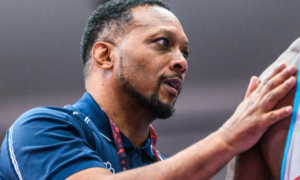
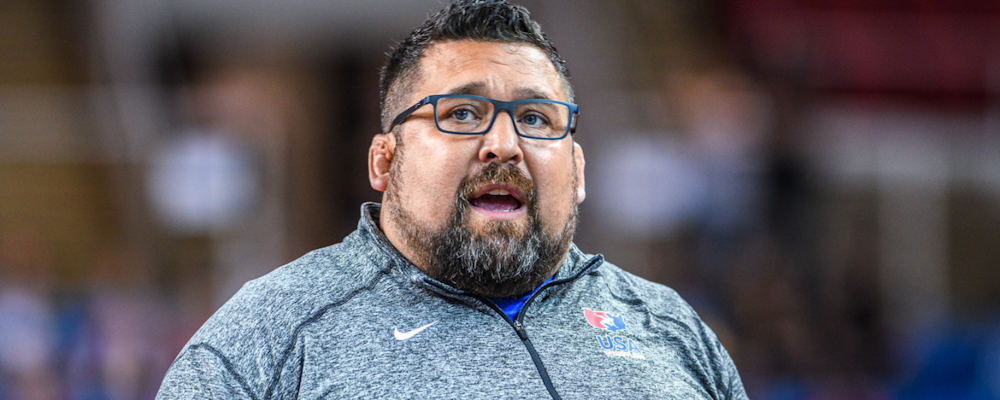
What the ’26 U20 World Team also has going for them is their coach, Zac Dominguez. Dominguez is of course an exceedingly well-known fixture when it comes to Greco-Roman in the US. The Nebraska native was a big prospect as a Division I wrestler in his home state before becoming part of the inaugural class at Northern Michigan University’s United States Olympic and Education Center (in ’99). Dominguez then went on to enjoy a strong Senior career but, these days especially, most associate him with his club, MWC, as well as with the various roles he has filled for the country’s Greco-Roman program. There is not an age level or skill level that is unfamiliar to Dominguez from a coaching perspective. And, with regards to impending concerns, he has manned the corner at a dozen World Championship tournaments.

Due to his wealth of knowledge and nearly two decades of full-time coaching, Dominguez is a critical asset to both the US program and this year’s U20 World Team. With their final preparation camp unfolding this week at the Olympic and Paralympic Training Center in Colorado Springs, Dominguez pressed the “pause” button on his busy schedule to talk about what this latest assignment means to him and how him and the US plan to resume finding success at the most pivotal age-group World tournament on the calendar.
Zac Dominguez — MWC
2026 U20 World Team Coach
5PM: At this stage, having already coached so many World Teams and with being one of the most prominent age-group coaches in the country, what has been your approach since taking the reins of the U20 World Team this year?
Zac Dominguez: Obviously, to first just get the Team going. In April, after we selected the Team, I introduced myself to everyone, got their phone numbers, and got a WhatsApp thread going. As things progressed, I wanted to learn as much as I could about them. I started watching video of each athlete who made the Team. I also went back and watched their whole (U20 Trials) tournament. That way, when we got to Croatia, I would have an idea of what they do when wrestling against other Americans and hopefully steer them towards what they might be able to do against foreigners. A couple of them had to learn some hard lessons from this, but a couple of them also surprised their counterparts in Croatia. Like Nick Sorrow. He is an unconventional wrestler who is coached by Nick Simmons in Michigan. He has ridiculously-wiry hips. The foreigners would go to lift him and he would cartwheel out of stuff. The foreigners would be like, What is happening? Manny Saldate at 60 (kg) is a hammer. He goes very hard. In the past, he was kind of good at Greco, but now he has really improved at hand-fighting and learning how to stay in the center.
At any rate, I did my homework on every kid on the Team. So coming up at this camp beginning on August 3rd (at the Olympic Training Center) in Colorado Springs, I will be giving them my sheets which basically say, This is what I know about you, this is what I’ve seen, and let’s build on this. They can also tell me if I’m off-base and so then we will adjust according to that. It is going to be about them. Not me telling them what to do. It is about me learning them and taking their feedback to help them grow in those areas. It is development from afar when it is not your own kid, so you can’t impress a lot of things on them. You just have to make sure that you come across as trustworthy and knowledgeable, and then they put their trust in you.
5PM: It is as though you have to allow them room to wrestle within the confines of their own interpretation of Greco and coach them based on that, just with making sure they have adequate position while doing so?
ZD: Absolutely. They are obviously good athletes. We have to give them some other tools and make small adjustments on what they do well. Let’s say one of them has a really good underhook. So then it will be, Okay, here is what a bodylock can look like for you if you want to get to that position. We would want to see what else they can do from that underhook, just to open up their brains a little bit more and add a couple of other things to repertoires.
5PM: How do you feel the kids who make this kind of World Team stack up to the type of kids who were making age-group Teams back when you first began coaching these kinds of rosters?
ZD: You know, I think that they are more technically-based. I don’t want to say that they are better technically in Greco, but they study their technique a little more than the kids did ten years ago when we went down to Brazil. At that Junior Worlds in 2015, our boy were just grinders. I remember they had the “push, push, push” mentality. They were more old-school and worked hard. Not that the boys nowadays don’t work hard, because they do. It is just different because they have more technique available to them.
Back in 2015, there wasn’t as much media around. Now, kids can watch videos and see techniques. My own Instagram is full of techniques. It’s like, Oh, that’s cool, I’ve never seen that before. I’ll just scroll through and watch and watch and watch — and that is what I think these kids are doing. They are capable of seeing more technique. Now, how they are applying it sometimes is a problem, but they are at least seeing it. A lot of these kids are doing their duck-unders or arm drags. We don’t have to go back and teach these things as much to a good Greco kid. In the past, a good Greco kid could be a grinder, push you around and beat you up just because he had that capability.
Now we don’t have to teach the basics like duck-unders and drags as much, or snapdowns. The kids are already doing that. We just have to put them in good Greco positions to score more points.So I don’t want to say that one group of kids is tougher than the other, but the level of technique in all three styles has really picked up over the past decade.
5PM: There are a few full-time Greco athletes on the roster such as Amryn Nutter, Arvin Khosravy, and Aidan Squier. Do they take on any sort of out-in-front role?
ZD: Squier is actually pretty quiet but when he’s in charge, he’s in charge. Nutter, Leister (Bowling IV), and Khosravy, they do great, but sometimes I feel like they do it because they think that they are supposed to do it. As in, they have to do it because they are the “Greco guys”. I wish they would let it happen more organically because they are good at leading, and they are good at wrestling Greco. But just don’t force it. I’ve talked to them about it. They don’t have to try to be leaders, they already are leaders. They just have to be themselves. Nutter understood that because he has a big brother, and I’ve known Alston and the Nutters forever. They’re doing it, but sometimes I think it is because they feel like they have to. And they don’t have to try hard at it, because they already are doing it, if that makes sense.
5PM: I would assume that part of you wants them to not worry about such a thing since they just need to focus on wrestling in the Worlds.
ZD: Right. I just told them the things a leader should do. A leader should always be on time for practice, and if something doesn’t feel good that they should talk to the coach. That way we are all on the same page. If one wrestler points something out to another wrestler, I want it to be that the first thing they do is to go talk to the coach. Whether good or bad. That’s why I told them, Let it be natural. And, If you show up on time, everyone else will show up on time. If they are hurt, they are going to take the lead on how we handle that. I actually talked to Leister about this. He had left a practice and I didn’t know it happened. So I texted him to ask where he went and he said that his ribs were hurt. I responded, “Okay, come back and we’ll talk about it.” And he understood. Obviously I didn’t yell or scream at him, but I did tell him, “You are setting a precedent and if you just get up and walk out, that’s a problem.” He was like, “Yeah, you’re right”, and he didn’t do it again. And not that he did it on purpose. He wasn’t trying to be disrespectful. It is just sometimes that is what kids do. It hurts, I’m done, I don’t want to play anymore. I’m taking my ball and going home (laughs).
5PM: I really like Ezekiel Witt, I like watching him and in the past at Cadet we got a a taste of how looks internationally. This time, he is at a higher level. What is your sense so far of how he goes about approaching this tournament?
Zac Dominguez: When I first saw him, he was timid, which was in Istanbul at the U17 Worlds. He was timid, but he holds good position. Over the past couple of years at North Dakota State, he has really come out of his shell. Whatever was inside, it is coming out of him. He gets out there and tries to light fires. He wrestled Caleb Noble in the finals and I would have told you that Noble was probably going to be the champ all day long — because I had remembered what Ezekiel was like. But then he went out there in a tough series and tech’ed Caleb Noble. Caleb had been more current with overseas stuff, was a returning World Team member, and he has a lot of pizazz. But when I saw Ezekiel wrestle him, I was super-impressed. Whatever was hidden inside of him at North Dakota State, they found it. I did want Ezekiel to come with us to Croatia but he went to the U20 Trials for freestyle. I really wanted him to get that experience because for that 55 kg bracket I think he would have found another gear by being out there.
5PM: That is a good example of what I was asking before, though. What is the challenge when you do have multi-style athletes in 2026 compared to 2015? Because the sport is better now, too.
ZD: It is better. It’s tougher and meaner, too. For me, in my world, I’m a one-sport guy. I know that a lot of coaches say that you have to let kids play all the sports they want, and I get that. Sure, baseball, football, whatever. I get it when they are seven or eight-years-old. I watch these kids and it is like they are crossing over into almost every sport. They’re playing soccer one day a week, baseball another day, basketball, and then they try to throw wrestling into that mix. After a while, I’m like, What are you doing? At some point, you have to stop filling multiple baskets and instead just focus on filling one. You have to just go, Okay, I’m going to invest my time and money in this one basket. It might be scary because it is kind of a risk. What happens if nothing good comes from your basket? Someone once said that it is like financial planning. You have to have your safety basket, risk basket, and so on. That way, you’re collecting awards here, awards there. Me? I’m going to throw it all in one basket.
I know that college coaches have a job to do, and their job is folkstyle. I understand that. But Greco is not even a basket for them. It is just…there. Thankfully, now that we can fund everyone who makes a World Team, they don’t have to pour money into it. They just have to figure out if they are going to send a personal coach, which I’m sure they will. But I do wish that Ezekiel would have come to Croatia. I think that he would have undergone more growth doing that than by going to the freestyle Trials.
5PM: How do you go about corresponding with the U20 wrestlers’ team coaches and personal coaches during the training cycle?
ZD: Sometimes we don’t even know who is going. Cheney (Haight) and I were discussing how it would be good to put notes out that we have. Because, obviously, their personal coaches aren’t going to come to camp; but at the same time, we would love if their personal coaches came to camp so that they we can be on the same page as them. Let’s say their personal coach is yelling to do something from the left side, and I’m yelling to do the same thing but from the right side. We’re both saying the same thing, we’re just seeing it from different sides. I wish that we could spend more time with those coaches. The problem is that we don’t know who is going until the very end. And sometimes, it is also like talking to air. We then have to lean heavily on the kids and say, Please give your coaches these notes and if they have questions tell them to text us. Because I might know who their coaches are.
One of our athletes had a coach come out who did not know anything about Greco. Now, the kid’s school did a good job by sending someone, but it was also like, Why would you send someone who doesn’t know a whole lot about Greco? In the end, this coach actually did a great job. He helped the wrestler a ton, did all of the things a coach should, and he was fantastic. I just wish that I knew more about him and his coaching style. It would help me a ton — especially because I’m going to sit in the back (during matches at the Worlds) and not the front.
5PM: Okay, so now the US selects only one U20 World coach when there used to be two. That means that every other coach who shows up is a personal coach, and most of those types of coaches may not be big into Greco and these coaches man the first chair. So what happens when a brick needs to be thrown? What happens when there is a small technical adjustment that needs to be made but it is one that the personal coach might not be able to identify? That to me is where the potential for disconnect seems to be.
ZD: And it is. That is the disconnect right there. Without a doubt. It’s hard. It really is. We cannot make this a policy, but we can make it a practice to say, If you’re going to be a personal coach, we would really love for you to come to camp. I mean, just for a couple of days so that we can see what you’re doing and you can see what we are doing. We can have some quick conversations and then you can leave, stay, or however you want to do it. But it would be big, very big, and I mean this for Greco, if those personal coaches did come out. Because — then when they leave, they might leave with a different point of view which says, Hey, Greco’s not so bad. I can do this a little more, maybe we can get some Greco going. The more coaches we can get to coach Greco, the more kids are going to wrestle Greco. That’s what it comes down to for me.
5PM: You are also the head of the Greco-Roman Sport Committee and you have been involved at this level of involvement in various form for such a long time. Other countries on a year-in year-out basis have the same dedicated staff for their own age-group World Teams. For the US, it is rotational and based in part on the coaches pool. It’s not the same guy all of the time, so there is turnover every year. I don’t see this as positive. Is there any way for someone to be the U20 World coach every year so that there is at least some sort of continuity and familiarity? Is there any way within our system to change this?
ZD: I would love for that to be what we do because I do want continuity. I think it is important. Even if we can just revolve a couple of guys with a group of kids, because at least then they are moving up in age level with that group. They start with the young ones and grow with them to the Senior level. At least they would be growing with that group. The problem is that many coaches think that they should be the head coach of a Greco team. They say things like, I had three National champs last year! Okay, but that actually does not mean that coach is more qualified than others who regularly volunteer their time. Every time I get picked, it is a big deal for Herb (House) and the rest because then it is, Now we’ve got to keep Zac off the list for a couple of years because he gets to go everywhere. And so people get upset, and I’ll feel bad, which is why I’ll then tell Herb that I’ll just go and help out at camp instead. If I have a kid on that World Team, I’m going to go, anyway.
And I shouldn’t say “When I get picked”, because there were a couple of years there when Matt (Lindland) was trying to create that continuity where there were a few of us for a while who started coaching U17’s, moved up to U20’s, then U23’s, and so forth. One year, I had a kid on every Team from U20 to Seniors. I was gone three months in a row. It was awesome. For one of them I was coaching as the leader, and for the other two I was a personal coach. But I was coaching those guys because I had grown with those guys, so it all made sense. But that’s the tough part: if you do show up, and you’re always showing up — and you get picked — it’s because you show up. But then there are guys from the outside who want to come in and they go, I don’t understand why I can’t get picked. For USA Wrestling, I get it, it’s a problem because they have to spread the wealth. And it is a position that is funded and they are only giving it to one person. Then it looks like I work for USA Wrestling because I’m a “picked” coach, and I totally get it. That’s why I’ll just tell Herb, If you need me to gap-fill or something, I’ll help you, but don’t feel forced to put me out there. I enjoy what I do and I’ll still go to camps, which I always do. And if Herb calls and goes, “I need you out here for a week”, then it’s Fine, I’ve got you.
The issue is that we need more coaches who just want to help, not for their own sake but for the sake of the kids and our sport. It is just that, too often, the only way that they want to help is if they can coach for the World Team.
5PM: You coached your nephew Cruzer at Fargo and he went on to win an enormous bracket. Given your years of coaching at that massive spectacle, what was it like coaching him to victory there?
ZD: First of all, I was super-proud of him. He was basically in a 256-man bracket, but really 132 because there were a three or four matches that had to be wrestled in that early round. He had to wrestle every match in that bracket in order to advance. He had eight matches. It was a lot of fun to watch him wrestle that many times.
You know, it is an honor and privilege when you get to coach your family, and I was able to coach his dad at Fargo, as well. I talk about this all of the time but his dad wrestled Harry Lester for 3rd/4th and in that bracket were some tough kids. And then my other brother, I coached him in the finals twice. He had beaten Jonathan Drendel in one of them and in the other he had lost to Kendrick Sanders when the rules were weird with the ball draw. I don’t even remember the rules (laughs) but I do know that he had outscored Kendrick, when you count up all the points, 10-7 or something like that. It was a bummer at that time. But Cruzer did a good job. He tech-fall’ed everyone and went to the second period only twice. He wrestled some really tough kids and he was the 6th seed overall. That means he had to beat the #3 seed, the #2 seed, and the #1 seed in the finals to win. It played out that way, so that means the bracket was drawn up really well. The PIN system is finally starting to get a little bit better and is beginning to place kids in the right spots.
Cruzer has had a really good summer with Greco. He wrestled out at the Adriatic Open in Croatia with the U20 Team, came out to camp with us there and had a blast. He wrestled with the Georgians, the Ukrainians, and a bunch of others out there and he got after it. He learned a whole lot. Hand-fighting is one of his specialties. He likes to get out there and just fight, fight, fight.
5PM: At this stage, what do you think his long-term interests might be?
ZD: You know, two years ago I would have told you that he was a freestyler but he really enjoyed Greco this summer. He acquired a really good blue-collar workman’s knowledge of it. He is coming out to camp with me this week for the U20 World Team. So, I don’t know. He might one of those special athletes like Brad Vering, who was an NCAA champion but he loved Greco. Maybe that is where he lands but I have no idea. I would have said that he was 60/40 on the freestyle side but, man, it’s about 50/50 now. So I’m not sure (laughs).
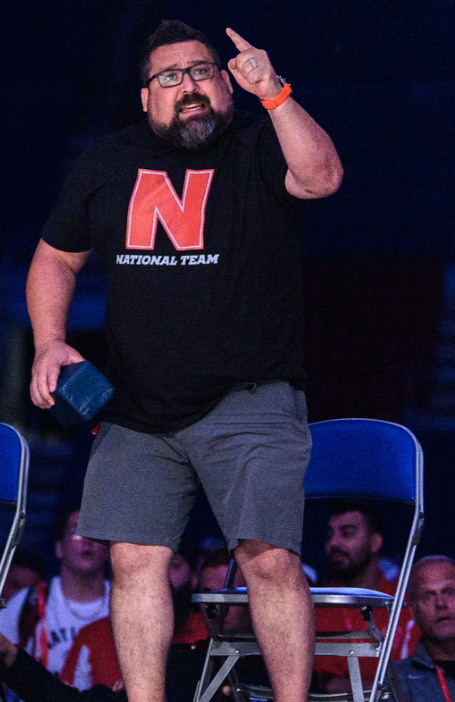
Dominguez coaching in the 2026 Fargo National finals. (Photo: Tony Rotundo)
5PM: Porec (Croatia) in June was the big overseas trip that sort of kicked off the summer for the U20 World Team. How did you go about identifying Croatia as the landing spot for that?
ZD: Cheney was telling me about it and we have had Seniors go over there before. Plus, with our selection process, we did take a tournament away from this age group by holding the Trials in April but we did add one foreign tournament in for those guys who made the Team. This way, we could go somewhere with them before Worlds. Cheney talked with Herb, and I think also that Marty Hauck was telling Cheney about this trip. Porec hosted Americans for four weeks. Our Seniors were there just ahead of us. When we were in Chicago to leave for Croatia, the Seniors were landing in Chicago from Croatia. It was funny. They were like, ‘Oh, you’re leaving for Porec? We’re just getting back.’ They had a camp out there plus a tournament. It was a really nice tournament. It was a good venue and pretty close to where we were staying. We didn’t have to get on a bus for 45 minutes. You could have walked to the venue from our hotel if you wanted to, which was really nice.
Cheney had laid out the deal to the ten kids. He told them that they were all funded and we had nine of the ten go because, as mentioned, Ezekiel didn’t go. Cheney then asked how many extra people we could bring and that number was 16. So, we essentially had seven spots. Cheney asked if I had any of my own guys who I wanted to bring, so I brought my nephew Cruzer Dominguez out as well as JT Smith. Will Scherer and Will Detar also came. In total, it was 14 athletes, two coaches, and our trainer. We landed in Munich, flew to Zagreb, and took a bus to Porec. That was the worst part, the three-hour bus ride to Porec. It was a long ride. We arrived two days before the tournament. The lighter guys wrestled the first day, the heavier guys went on the second day, and the girls tournament was mixed in there, too. They had I think 205 athletes for Greco and the girls had around 60, so not a lot. We had two finalists with Leister and Cruzer. We also had two guys wrestle for 3rd who ended up 5th. We finished 5th as a team, which I thought was pretty good. It was a tough competition.
Then we got into camp and it was fantastic. During the first week, there were 12 teams there and we had to split the sessions according to weight. 55 to 72 kilograms went from 9:30am to 10:45am and then 10:45am to noon it was 77 to heavyweight. For three hours in the morning and three hours in the afternoon we were stuck in that gym as coaches, but it was super fun. It was one of the few times when you go to a camp like this — and I don’t think that the Juniors had done this before — where we were not running the camp. Usually, it is us running the camp. Cheney will say something like, Okay Zac, you’ve got to do this and that, and demonstrate this and that. And I go, Okay, because then I’m worried about what I’m going to do and Cheney is worried about what he’s going to do. Here, the Croatian coaches ran the camp and that allowed us to watch our wrestlers wrestle. We got to sit there and eyeball our guys, which was a lot of fun. We would just tell them, Don’t train with each other, go find a foreigner. And they were very good at that.
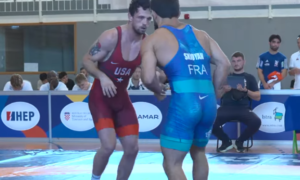
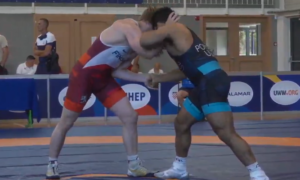
On match days, we got to coach them. Not that we were screaming and yelling, but we would get them for the :30 breaks. We got to really focus on our guys and I think that made a big difference for us with this Junior Team. I think that it will help them because we were able to identify some weaknesses. One of our major weaknesses was movement in par terre, which we all know that in the United States. But they were figuring it out and that was good. Oh, this guy is going to lift and throw me, I’ve got to get it together and start moving on bottom. On our feet, if we were losing in the beginning we were 50/50 by the end. And sometimes we were winning those matches in the end. It was really good to see.
In my opinion, camp was really good overall. If I had to give a grade, the only thing that I would say is that it was a two-week camp and so it was a little long. Ten days probably would have been a better time-frame because we really did grind it out. The boys were tired, beat-up, and a little sore. We did get the weekends off in the middle but we went to Venice on a Saturday, so we were probably a little more active than we had to be. But it was good. It really gave us an opportunity to see some development in nine of our World Team members and hopefully we will have Ezekiel up to par at this next camp. But it was really a fantastic camp. We learned a lot. I also got to meet some new coaches and made some good contacts. I had a really good time as far as wrestling goes. It was very laid-back and not over-the-top because Porec is right on the ocean. Kids got to go to the beach. It really was an extremely fun trip and the learning part of it was fantastic.
5PM: How does the camp from Porec inform the curriculum for this August camp in Colorado Springs?
ZD: When we start camp, all of the notes that Cheney and I have, we’ll use those to lay out when we do certain things. We already know the positions we want to work on. Now we are going to do the techniques to fill those in. Cheney was talking with the French coaches out there and their arm drag is just a little bit different. Their 67 kg guy was really good at this drag and all three of the coaches were doing it. So then I was like, Why can’t I do this? So one of the coaches says, “Because you’re looking for head position. We’re looking for shoulder position.” I was like, What did you just say? Stop, say it again (laughs). Because, we do. In folkstyle, it leads us to look for head position. So does freestyle, and we do the same thing when we come over to Greco. We try to get our heads in there but the problem is that our heads go down when looking for that position. But if we look for shoulder position, it goes right underneath their chin; our head goes up and you stick that foot right in the middle. That is going to be a big area of concentration for us at camp, looking for shoulder position as opposed to head position. It makes a world of difference for what your level change looks like, what your corner looks like… It’s crazy how that one little statement was so impactful.
5PM: What were some of things that you saw the Americans do better than the foreigners who they were wrestling in camp or in matches on the Croatia trip?
ZD: #1, because we are from the United States, our conditioning was always better. That is just, plain and simple, always our bread and butter. The next thing that I saw them do was adjust quicker. When they were losing a position, they could figure out why they were. I saw that as a very good thing but now we’ve got to be able to do that in a match. But — they would take it with them from practice to practice. Now they are going to have to be able to figure that out in two minutes. They were evolving quicker in their positions and their techniques. The other countries, like the Georgians, they do their moves, right? This is my technique, this is how I’m going to score, and then I’m going to lift you, I’ll be up 6-0 and now I only need two more points and the match is over. If not, then I’ll win 6-0. But now, with adjusting, instead of it being 6-0 it becomes 2-0 because we beat the lift. Then it happens that we beat the first takedown and we’re countering, or we’re countering on the way down and he gets two but we get one and we’re on top. Their ability to adjust inside those matches was so much better than I have seen in a long time. I think that they are just really good athletes.
As for the third thing, I will say it this way: if you were on the U20 Team from Northern Michigan, you were probably the only guy who had a good arm throw, headlock, or arm spin because you learned how to throw. Now, all of our guys can do those things. They are doing these techniques well, too. The basic level of technique has risen among this group of kids to where they are throwing better. When I was at Northern Michigan, I already knew how to throw because I was a Greco-Roman wrestler. It was why I went to Northern. But — I learned how to speed throw there. So, now, I figured that I would have to walk them through speed throws. Instead, it was, No, we know how to do it. And that goes back to the coaches these kids have. Our heavyweight (Travyn Boger) comes from Kyler Sanderson, who I work with in PNL, and our 97 (Cittadino Tuttle) works with Brandon Paulson, so he knows how to throw. Our bigger guys are throwing. With the basic level of technique increasing, we don’t have to go over that stuff as much to begin. We can start with good positions. We can start with two-on-ones and determining how to get to a step-out, how to get to the body. It’s the same thing with an underhook.
5PM: For those who are first-time World Team members, how do you prepare them for the intensity and level of competition that they are going to encounter in that tournament?
Zac Dominguez: That is definitely going to be one of our main speaking points in our meetings. Cheney wants to have one or two sports psychology meetings and one or two nutritional meetings while we’re at camp. I am all for it, plus it will help the kids clean it up a little bit because by the time we leave it will be two weeks out from the tournament. That is going to be one of the things. If I had to speak to it now, I would say that everyone knows what it is like to get up for a tournament. Everyone has gotten themselves ready for a state tournament, the Nationals… What I would tell them is, You have all been to the top level here in the US; now you are going to a tournament where the level is a little bit higher — but it’s not different. You just can’t let it get out of control. That’s what I want to tell them. They have done this before. You get out there, it’s the round-of-32. It doesn’t matter who the opponent is, everything is 100%. It doesn’t matter because there is no seeding here. That is the one thing that I want them to understand — there is no seeding. Oh, I’m in the bracket at this spot so I probably have the 7th seed. And it’s like, No, no, that is probably a three-time World champ so stop it. Don’t think of it like that. And a lot of them do that because that’s how it is here.
I just tell them to look at it like everyone they are facing is the World champ and they have to give 100%. I tell them to wrestle as perfectly as they can. Is it possible to wrestle perfectly every time? No, but I want them to strive for perfection in everything they do. From the warm-up, to the match, to the cooldown. For those two days, everything is yours. You have to be selfish at the tournament. It has to be all about you as far as the competition is concerned and you have to make it that way. The coaches will be there to back them up, I’m sure some of the parents will be there to do the same. We’re going to be there for them. Everything they need is supported. I would just tell them to have fun and to strive for perfection in their matches.

SUBSCRIBE TO THE FIVE POINT MOVE PODCAST
iTunes | Stitcher | Spreaker | Google Play Music