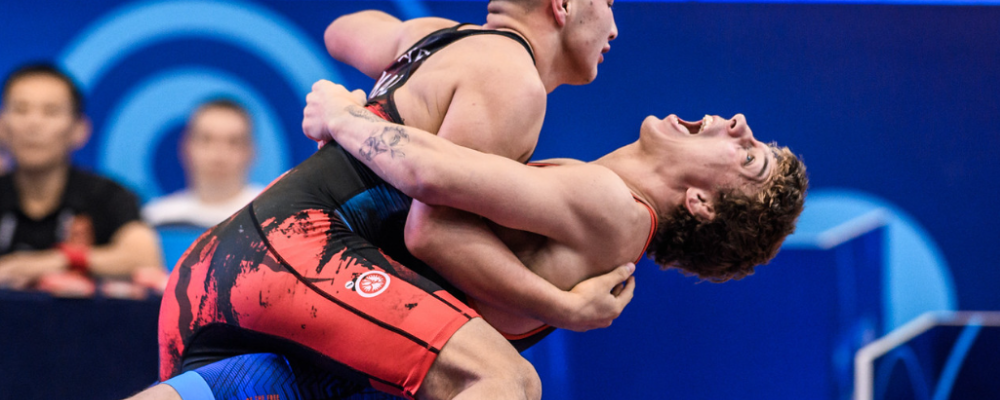
Numbers do not render a complete picture of why an athlete has triumphed or been defeated, but metrics can assist observers in deciphering how outcomes were determined. In the case of both Otto Black (67 kg, NYAC/NTS) and Payton Jacobson (87 kg, NYAC/NTS) — the Northern Michigan University duo who two weeks ago in Serbia earned U23 World bronze medals in their respective weight classes — their successes came down to three key areas: attempts, par terre scores, and par terre defense.

Scoring points matters, but the word “how” requires prioritization. Of course scoring matters. That is a redundancy (admittedly, an argument could made to the contrary given the presence of passivity points). The “how” for Black and Jacobson traces back to the “why”, which for both were attempts on-the-feet.
Although definitions and descriptions for 5PM’s Greco-Roman Statistics will be discussed below, full articles on the subject are available here (general) and here (par terre).
On-the-feet attempts are valuable for a variety of reasons. They lead to scores, open up secondary options, exploit vulnerabilities, may result in the fatiguing of opposition, and more. A high number of attempts does not necessarily correlate with more scoring — but it helps. As such, attempts will be the first category covered for Black and Jacobson.
Attempts
An attempt is when a wrestler engages his opponent in a direct fashion in order to score. The introductory piece on this topic also defined an attempt as when “the initiating combatant causes or compels a discernible defensive reaction or aggressive counter”. A short arm drag or the slithering of an underhook that does little other than goad an opponent into resetting his feet or switching off to an alternate tie-up would not be construed as an attempt. An attempt is overt and as such demands an overt reaction from the opposing competitor.
The main qualifier when deciding what is or is not an attempt is the response of the opponent, just as a main item to keep in mind is intent. Greco-Roman wrestlers are constantly waging war in close quarters and will push, pull, fling, and snap amid fleeting exchanges which, on the sport’s top level, often do not bear immediate fruit on the scoreboard. The lot of these miniature battles are simply a demonstration of the mechanical energy being expended by the participants. An attempt stands out in the dense fog of this nuanced chaos, even if said attempt came and went within a fraction of a second. So long as it can be observed that the initiator acted with an intent to try and score, and the opponent was forced to react with a suitable degree of exertion, what you just witnessed was an attempt.

However, different wrestlers express attempts in different ways, each according to his own style of attacking, and each according to his own body type. For example, Black wields sufficiently long reach for a 67 kg athlete and may sporadically laser one of his arms around the back of his opponents without having closed the distance. Jacobson, who for 87 kg is stocky and stout , does this, as well, but with less frequency. Jacobson is much more inclined to work for attempts from two-on-ones and underhooks with zero space between him and his opponent. Because that is the nature of both his style and the dynamics of his weight class.
Attempts for Black
Across his four matches in the U23 World Championships, Black was credited with 27 attempts, an almost mind-numbing number. But for him, stylistically, it was necessary. Attempts for Black in the tournament included duck-unders, other methods of level changes, and quick looks at reach-arounds — as well as in one instance a swat at a headlock, and in another, a salto. He was wrestling an open game by comparison to the opposition he encountered, which is saying something considering that he competed against athletes from three regions of the globe — two from Europe, one from Africa, and one from Asia. Black dealt with variety.
He was also effective because his attempts translated to six On-The-Feet Scores (OTFS). A debate could be made that two sequences were counter-scores; but even if they were, those chains were ignited by attempts, anyway.
vs. Adomas Grigaliunas (LTU)
Period 1: 2 attempts, 1 score (takedown, 2 pts).
Period 2: 3 attempts, no scores.
vs. Yanis Guendez Nifri (FRA)
Period 1: 3 attempts, no scores.
Period 2: 3 attempts, three scores (2 takedowns and 1 step-out, 5 pts).
vs. Mohamed Abdelkerim (EGY)
Period 1: 0 attempts.
Period 2: 8 attempts, no scores.
vs. Bagdat Sabaz (KAZ)
Period 1: 5 attempts, 1 score (takedown to immediate turn, 4 pts).
Period 2: 3 attempts, 1 score (takedown, 2 pts).
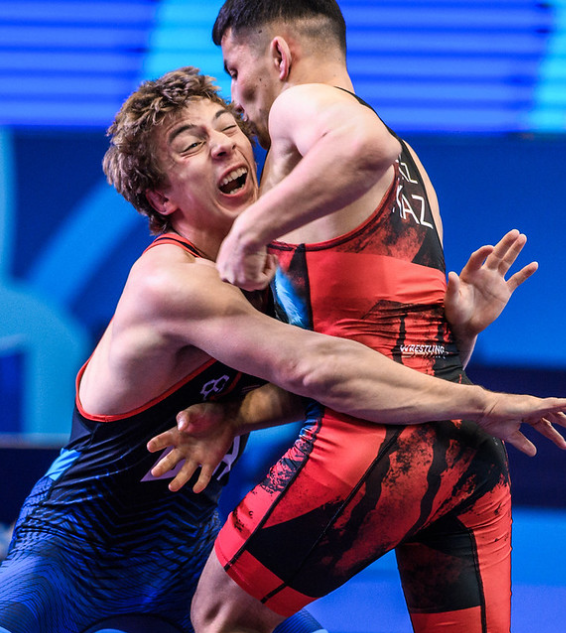
Black gave opponents numerous looks, and therefore his attempts included plenty of variety when it came to him hunting for direct body attacks. (Photo: Tony Rotundo)
The match versus Abdelkerim, in which neither athlete scored an offensive point, delivered an important reminder. What might appear aberrative is actually quite common, and is a common issue in Greco-Roman wrestling: it can be difficult for athletes to make attempts on-the-feet against opponents whose strategy and tactics are resistant to engagement. This is not a critique of Abdelkerim so much as an observation of his approach to Black. We refer to opponents who are amenable to action as “willing dance partners” and on age circuits above U20 they are a rare commodity. Abdelkerim consistently held Black’s hands and wrists, and in general bottled him up at every available opportunity. Interestingly, Black had zero attempts in Period 1 opposed by Abdelkerim but skyrocketed to eight in the second period, his high for the tournament. Whatever adjustments Black might have made during the break seemingly worked, just not enough for him to gain an offensive score.
More important are the positive score results. Black surrendered four points in total on-the-feet during the tournament (takedowns to Grigaliunas and Sabaz) but scored 13. In other words, he outscored his opposition on-the-feet by a combined margin of 13-4. That lopsided number is, obviously, one big reason why Black is now a two-time World medalist.
Black’s On-the-Feet Stats
ACR (Attempt Conversion Rate): 4.5
APP (Attempts Per Period): 3.4
APM (Attempts Per Match): 6.75
OTFPA (On-the-Feet Points Average): 3.25
OTFSR (On-the-Feet Scoring Rate): 1.5
Attempts for Jacobson
Jacobson was credited for 20 attempts in Serbia, which for 87 kilograms in this era is exorbitant. It is likely also a lower number than what would have been produced had Jacobson not disposed of Rohit Bura (IND) in the opening period of their qualification round contest, and similarly if Jacobson had not been stopped by eventual champ Gholamreza Farokhisenjani (IRI) just prior to midway through the first period in the semifinal. Black did trump Jacobson in APP (3.4 to 2.5) and ACR (4.5 to 4.0), but recognizing the difference in landscape is part of the story.
vs. Rohit Bura (IND)
Period 1: 4 attempts, 1 score (step-out point).
vs. Gabriel Lupasco (MDA)
Period 1: 1 attempt, 1 score (step-out point).
Period 2: 2 attempts, 1 score (step-out point).
vs. Zaur Shangereev (RUS)
Period 1: 2 attempts, no scores.
Period 2: 0 attempts.
vs. Gholamreza Farokhisenjani (IRI)
Period 1: 2 attempts, no scores.
vs. Lachin Valiyev (AZE)
Period 1: 5 attempts, no scores.
Period 2: 4 attempts, 2 scores (correct hold and takedown, 4 points).
When contrasting Jacobson’s and Black’s on-the-feet numbers, again, it comes down to their custom wrestling styles, the type of opposition with which both contended, and the dynamics of their respective weight categories. 87 is much more of a “snug” weight division, and Jacobson — who displays refined technical qualities but with brutish authority — has to fight through and conquer what are oftentimes lumbering positions in effort to create wedges with barely enough space to engineer meaningful attempts.
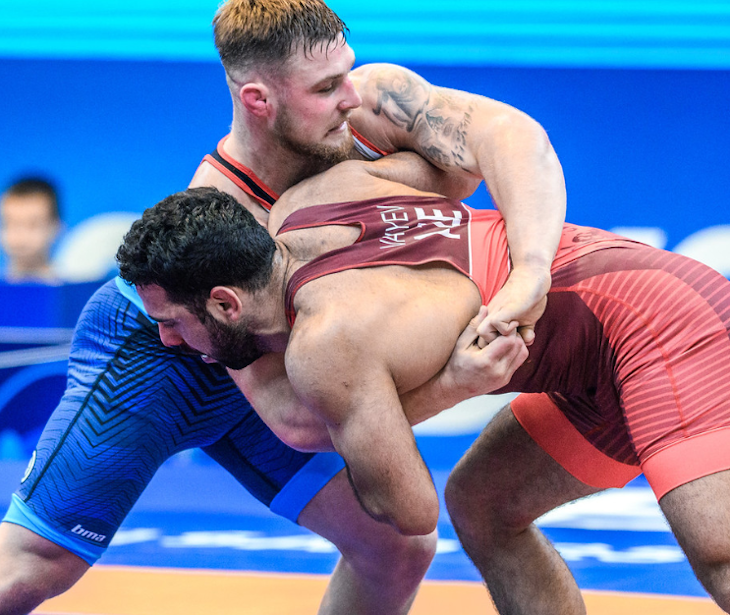
Jacobson’s (blue) attempts against opponents at the 2025 U23 World Championships came in tight quarters and were derived from a high work-rate that in several cases led directly to pivotal scores. (Photo: Tony Rotundo)
Which is why Jacobson’s OTFPA of 1.4 is, for 87, practically sparkling. And remember, these are metrics which do not take into account points distributed by way of passivity or cautions. They are strictly earned offensive points. Jacobson in the tournament earned three step-out points and two takedowns. 20 on-the-feet attempts and five successful scores (in five matches) is a tournament stat line most competitors at 87 kg would gladly embrace, especially in a climate which sees the majority of international upper-weights depend on par terre points.
Jacobson’s On-the-Feet Stats
ACR (Attempt Conversion Rate): 4.0
APP (Attempts Per Period): 2.38
APM (Attempts Per Match): 4.0
OTFPA (On-the-Feet Points Average): 1.4
OTFSR (On-the-Feet Scoring Rate): 1.0
Jacobson earned a total of 7 OTF points in the event and surrendered only a solitary takedown in return, which was when he had attempted an arm throw against Shagereev that the Russian countered for a land-on-top. As such, Jacobson outscored his opposition in Serbia on-the-feet 7-2.
Par Terre Defense
The pair’s OTF prowess were undoubtedly instrumental in their bronze-medal runs last week. But neither would have medaled, or wound up in position to do so, had it not been for what they accomplished in par terre. For Black, that meant exhibiting outstanding defense; for Jacobson, it was skewed more towards the offensive concerns involved with par terre.
Black’s PTD Numbers
A primary objective associated with par terre metrics is that one should be able to look at the statistics and immediately gain a sense of an athlete’s competence in this area. Numbers corresponding with OTF attempts are helpful, but perhaps leave too much to the imagination.
So let’s start right away with the most remarkable stat for Mr. Black: his Par Terre Defense Rate (PTDR) at the U23 Worlds was 83%. Another would be that Black’s PTPS (Average Par Terre Points Surrendered) in the tournament was a mere 0.5. This is, make no mistake, the #1 reason why Black’s overall performance should be analyzed and studied by coaches — age-group and Senior alike — around the country. Everyone should watch and re-watch what he was doing from bottom par terre against World-caliber competition, and the numbers alone are enough to warrant intense visual examination.
Key term: PTB (Par Terre Bottom) — situation in which subject was on bottom/defense in par terre.
Black — PT Defense
vs. Adomas Grigaliunas (LTU)
Period 1: 0 PTB
Period 2: 2 PTB, 2 Defends
vs. Yanis Guendez Nifri (FRA)
Period 1: 0 PTB
Period 2: 1 PTB, 1 Defend
vs. Mohamed Abdelkerim (EGY)
Period 1: 0 PTB
Period 2: 1 PTB, 1 Defend
vs. Bagdat Sabaz (KAZ)
Period 1: 1 PTB, 1 Defend
Period 2: 2 PTB, 1 Defend (2 pts surrendered).
When glancing at the statistics above, an observer can readily discern that Black succumbed only once from bottom par terre, which came in his last match against Sabaz. Sabaz had garnered a late takedown and went on to score two points from a gutwrench. The reason why this instance was recorded as a legitimate “static” par terre is because Black was able to establish a defensive posture after being taken down.
“Clutch factor” — “clutch” is not something which can be quantified, but in-match circumstances are permitted to be acknowledged and noted even when conducting statistical analysis.
When Black took the mat against Sabaz, both wrestlers understood that, because Atilla Jozsa of Hungary had been scratched from the bronze round, their repechage match had become the medal match. Black defended against Sabaz two out of three times with a medal on the line and surrendered only one two-point turn in the process. That is worth acknowledging. Other than Sabaz, none of Black’s opponents came all too close to gaining a score from top par terre.
Black’s PTD Stats
PTDR (Par Terre Defense Rate): 83%
PTPS (Average Par Terre Points Surrendered): 0.5
TPTB (Total Par Terre Bottom): 6
TPTPS (Total Par Terre Points Surrendered): 2
Jacobson — PT Defense
vs. Rohit Bura (IND)
Period 1: 0 PTB
vs. Gabriel Lupasco (MD)
Period 1: 0 PTB
Period 2: 0 PTB
vs. Zaur Shangereev (RUS)
Period 1: 2 PTB (2 Defends)
Period 2: 0 PTB
vs. Gholamreza Farokhisenjani (IRI)
Period 1: 1 PTB, 0 Defends (8 pts surrendered).
vs. Lachin Valiyev (AZE)
Period 1: 0 PTB
Period 2: 1 PTB, 0 Defends (2 pts surrendered).
Jacobson does his bidding in a weight category where outcomes are mightily influenced by par terre as scoring from the feet becomes increasingly less common above 72 kg.
Jacobson had only two negative PTB situations at the U23 World Championships, one of which was costly, and the other would have been had Jacobson not taken matters into his own hands. In the semifinal, Farokhisenjani (who is likely to be a candidate for United World Wrestling’s Wrestler of the Year award due to having won both the Senior and U23 Worlds) was gifted the bout’s first and only passivity/par terre opportunity and clamped a trapped-arm gutwrench on Jacobson before rotating the lock four times to win via technical superiority.
In the bronze round, Valiyev turned Jacobson once with a gutwrench after receiving the second-period passivity call. Valiyev’s gutwrench for two points put him ahead on criteria, but Jacobson struck back soon after by doggedly-pursuing what would become the match-winning takedown.
However, Jacobson found himself on PTB twice against Shangereev and did not yield any points. His first two opponents of the tournament, Bura and Luasco, respectively, did not have opportunities from top par terre.
Therefore, Jacobson’s PTD stats are not as glossy as Black’s. He had two less PTB (4 to Black’s 6) and surrendered 10 total points from the position. But — Jacobson’s PTDR of 50% from the U23 World Championships is respectable and his PTPS of 2.0 translates to medal contendership in most tournaments.
Jacobson’s PTD Stats
PTDR (Par Terre Defense Rate): 50%
PTPS (Average Par Terre Points Surrendered): 2.0
TPTB (Total Par Terre Bottom): 4
TPTPS (Total Par Terre Points Surrendered): 10
Jacobson’s best par terre work was derived from the component of the position where damage is done, not from where it is avoided.
Par Terre Offense
Jacobson — Par Terre Offense
For starters, Jacobson’s PTEP (Par Terre Execution Percentage) in Novi Sad was 60%, an excellent number that automatically indicates effectiveness. This percentage is easy to comprehend: 60% of the time Jacobson was on top PT, he scored. We’re not looking at how many points he scored from top PT with PTEP, only that he acquired points commensurate with his opportunities to do so.
To dig deeper necessitates isolating each instance of scoring. Jacobson lifted Bura for four, gutted Lupasco twice for four points in his lone PTO, and lifted Shangereev — clutch style — for four in the second period. Add them together and that is four scoring actions for Jacobson from top PT in five matches totaling 12 points — giving way to a PTSM (Par Terre Scoring Per Match) of 2.4. But it is his PTEP of 60% on which most should be focused because it is terrific and may only increase as his career progresses.
vs. Rohit Bura (IND)
Period 1: 2 PTO (1 scoring action, 4 pts).
vs. Gabriel Lupasco (MD)
Period 1: 1 PTO (2 scoring actions, 4 pts).
Period 2: 0 PTO
vs. Zaur Shangereev (RUS)
Period 1: 0 PTO
Period 2: 1 PTO (1 scoring action, 4 points).
vs. Gholamreza Farokhisenjani (IRI)
Period 1: 0 PTO
vs. Lachin Valiyev (AZE)
Period 1: 1 PTO (0 scoring actions).
Period 2: 0 PTO
Jacobson’s PT Offense Stats
PTEP (Par Terre Execution Percentage): 60%
PTSM (Par Terre Scoring Per Match): 2.4
PTPA (Par Terre Points Per Action): 3.0
Black — PT Offense
Par terre offense was not a major source of points for Black in this tournament, which was fine because he scored in other ways and — more importantly — his PT defense was superb. Black recorded four total points from par terre top stemming from two actions in the same PTO (a pair of gutwrenches against Grigaliunas).
There is a sticking point worth mentioning so as to clear up any potential confusion (and this was covered in the original Par Terre stats article from 2020): the scoring action known on this platform as a “takedown-gut combo”. This is when the offensive wrestler, through a variety of means, manages to get behind his opponent and take him to the ground where, upon impact, immediately converts at least one turn. These sequences are observed as a single OTF action because there is no “static” in which the bottom wrestler can reasonably establish a defensive posture (hence why coaches often exhort athletes to try and score immediately following takedowns, as the bottom wrestler is often far too vulnerable to adequately defend). Black has achieved scores similar to the one described previously and did so in Novi Sad. They just aren’t tabulated as par terre scores.
Black’s PT Offense Stats
PTEP (Par Terre Execution Percentage): 20%
PTSM (Par Terre Scoring Per Match): 1.0
PTPA (Par Terre Points Per Action): 1.25
A PTEP of 20% does not jump off the page, nor should it. But whether the stat line is from a single tournament that contained four matches, or spread out over a prolonged period of time and is representative of many matches, a 20% PTEP when juxtaposed with an 83% PTDR suggests that the subject has recorded successful outcomes on a consistent basis. Offense is clutch, but wrestlers simply cannot win consistently without defense. Not on the level where Black and Jacobson compete, at least.
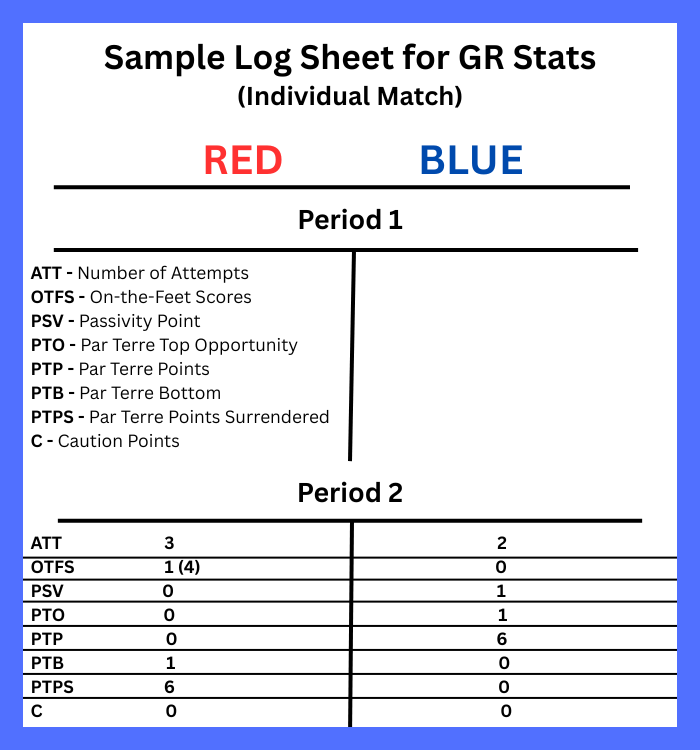
SAMPLE BOX SCORE STAT SHEET: According to this sample, Red gained one OTF score worth four points in the second period but was also called for passivity. Blue received the passivity point and subsequently scored six points from PT top. The score is thus 7-4 for Blue, with six of Blue’s seven points coming from offense.
Complete Statistical Overview
As a refresher for those already familiar with 5PM statistics, or as an introduction for those who might be new, below are additional metrics which are being applied for Black and Jacobson.
— PPM (Offensive Points Per Match)
— PPP (Offensive Points Per Period)
— MPSM (Multi-Point Scores Per Match)
— CSPM (Cumulative Scores Per Match)
— AMV (Average Margin of Victory)
— VFR (Victory Finish Rate)
— TOPS (Total Offensive Points Scored)
— TPS (Total Offensive Points Surrendered)
Otto Black (67 kg, NYAC/NTS)
2025 U23 World Championships
WON Adomas Grigaliunas (LTU) 7-3
WON Yanis Guendez Nifri (FRA) via fall
LOSS Mohamed Abdelkerim (EGY) 1-1 (criteria)
WON Bagdat Sabaz (KAZ) 8-6
WON Attila Jozsa (HUN) via forfeit
ACR: 4.5
APP: 3.4
APM: 6.75
PPM: 4.5
PPP: 2.25
OTFPA: 3.25
OTFSR: 1.5
PTEP: 20%
PTSM: 1.0
PTDR: 83%
PTPS: 0.5
MPSM: 1.75
CSPM: 5.5
AMV: 3.6
VFR: 33%
TOPS: 18
TPS: 7
Payton Jacobson (87 kg, NYAC/NTS)
2025 U23 World Championships
WON Rohit Bura (IND) 8-0, TF
WON Gabriel Lupasco (MDA) 7-1
WON Zaur Shangereev (UWW) 5-3
LOSS Gholamreza Farokhisenjani (IRI) 9-0, TF
WON Lachin Valiyev (AZE) 5-3
ACR: 4.0
APP: 2.5
APM: 4.0
PPM: 3.8
PPP: 1.88
OTFPA: 1.4
OTFSR: 1.0
PTEP: 60%
PTSM: 2.4
PTDR: 50%
PTPS: 2.0
MPSM: 1.2
CSPM: 5.0
AMV: 4.5
VFR: 25%
TOPS: 19
TPS: 13
The most streamlined summation of the Americans’ bronze-medal winning performances from the U23 World Championships is that they both, on average, scored more points than their opposition. TOPS over TPS provides that perspective rather quickly. The issue is that neither number tells users much else about an athlete (TOPS and TPS are for casuals). With APP, APM, and OTFPA, observers can uncover a wrestler’s OTF tendencies, while PTEP, PTSM, PTDR, and PTPS directly demonstrate his effectiveness in par terre. When combined with PPM, MPSM, and then including TOPS and TPS, a fuller picture portraying an athlete’s overall competence is availed.
Black and Jacobson — each by deploying his own customized methodology — both expressed an earnest desire to generate motion and create attempts (they combined for nearly 50 of them). The result of this shared approach is visible within their respective OTF metrics. Black had just under 7 attempts per match and 15 of his 18 offensive points scored in the tournament came from the feet. Jacobson — who, again, competes in a weight category that is not exactly “scoring friendly” — averaged 4 solid attempts per match and did not score as many OTF points as Black — but he also did not have as much match time. We know that Jacobson was not hurt in any way by his “less” (relative considering the weight category) attempts because his PTEP, MSPM, CPSM, and AMV indicate that he recorded scores in other areas.
Hidden Value in Attempts?
A leap it is not to suggest that more attempts means more scores, and more potential scoring opportunities. But what about the concept that the value of attempts is even greater than can be understood by OTF metrics alone? And, by extension, how the type or method of an attempt, along with quantity, might influence a match’s outcome?
For instance, can any of Black’s PTD success from the tournament be attributed to his rate of OTF attempts? Is there a direct correlation or only an implied one? The same can be asked of Jacobson’s PTEP. Did his bruising pace, physicality, and tactics for creating OTF attempts aid in his ability to execute from PT top?
It would seem that nearly every coach, as well as the majority of experienced current and former athletes, may enthusiastically agree that, indeed, OTF attempts are significantly influential from both a physical and tactical standpoint when it comes to par terre. So much so that they might express a sense of bewilderment that such a correlation is even questionable. To them, it is self-evident, if not glaringly obvious. The problem? Without corresponding datasets, that which may be conceptually obvious to some is nothing more than an inconclusive hypothesis to all.
Going forward, here are three potential methods (for coaches, trainers, athletes, and statisticians) worth applying:
1) Biometric data acquisition
Not all attempts are created equally and we know this because different attack types tend to require different degrees of physical exertion. An arm drag, while explosive, is not as physically-demanding as a bodylock or lift from the feet. Conversely, the direct defensive or counter-scoring measures from an opposing wrestler during these situations also necessitates a physical response commensurate with the action that he is trying to thwart.
We can surmise the cause-and-effect attempts — and different attempt types — might have on athletes, but sans accurate corresponding data one cannot know with any reasonable certainty. Real-time biometrics addresses this quandary. The institution of wearable biometric devices during practices, be it while drilling or in “live” situations, would provide coaches and wrestlers with the data-centric feedback they need to discern the effect attempts, and different attempt types, have amid various phases of a training block. The number of attempts a wrestler engages is pertinent; but the next step in uncovering how effective attempts are and could be is all the more clearer by referring to biometrical data. This practice had been utilized previously by the US program primarily due to the late Mark Halvorson’s involvement with the 2016 Rio Olympic Team. They measured VO2 max thresholds and heartrate deviations pre and post-training circuits, and Halvorson was able to track all data from participants as it was acquired. This data was used to inform various fitness goals that were tailored to each athlete’s physical and competitive profile.
2) Count them all
Only the OTF output and PTD from Black and Jacobson were observed for this piece, thereby rendering the data somewhat incomplete. Why? Because none of the output (attempts, OTF scores) from their opponents was taken into account. In order to better gauge the effect of attempts, it would be helpful to measure the number of attempts from opposition and then discern if there are patterns which develop throughout the course of a match or period. If the attempts from one wrestler take a toll on the other in the form of fatigue or the surrendering of more scores, over time this would be realized via statistical patterns which can only become visible by counting all of the attempts from both competitors. 5PM does have a statistical category for (as mentioned) counter-scores, but they were not applied for this particular exposition.
3) Comparative analysis
One avenue in which the potential impact attempts have pertaining to competitive performance can be explored via comparative analysis. If anything, comparative analysis is the most easily-sourced and dependable exercise from which to draw conclusions. The lone issue is that the observable data should possess competitive congruency so as to avoid arriving at muddled or disjointed metrics. For example, comparing Otto Black’s statistics from the ’24 U20 World Championships (at which he earned silver) to his stats from the ’25 U23 Worlds is quickly achievable, and might have a semblance of value, especially for his coaches; but given that U20 and U23 are different levels of competition, it would be fair to call into question the veracity of any statistical conclusions one might reach by comparing the numbers from both events.
But, for the purposes of this article, we do have enough of a U23 sample size from Jacobson to conclude that the number of attempts may influence overall effectiveness and produce more favorable outcomes. Jacobson competed in three consecutive U23 World tournaments — ’23, ’24, and ’25. He was limited to only one match in ’23, but in both ’24 and ’25 he had five matches. Ten combined matches from the same tournament level only one year apart meets the standard of congruency. (See graphic below.)
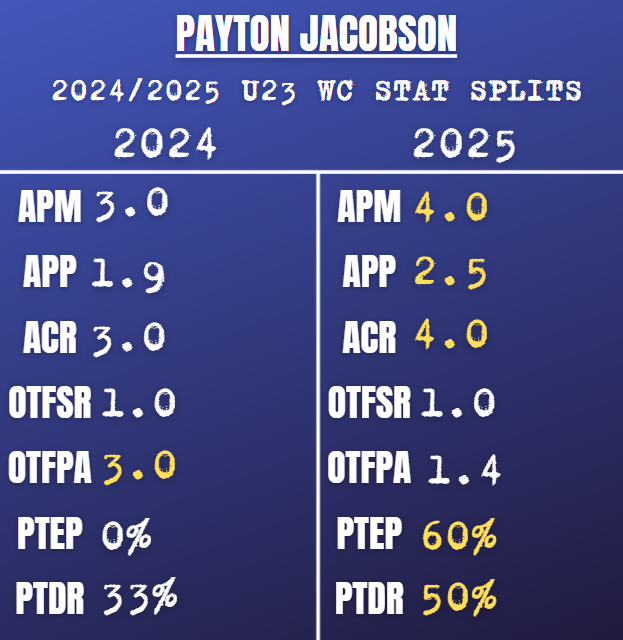
Jacobson’s OFTPA from the U23 Worlds was higher in ’24 as in that tournament he had torched Yudai Kobori (JPN) with a pair of fours from the feet and recorded OTF scoring actions against two other opponents (one of which being a four-pointer versus Ilya Mialeshchyk of Belarus). His OTFSR was the same for both years, as well, but every other statistical category saw a relevant uptick in ’25.
Beneath the surface, Jacobson’s improved metrics can naturally be attributed to continued technical progression, an expanding skill-set, greater strength and conditioning, and intangibles such as mental toughness and competitive confidence. But we don’t actually know if any of that is true, whether or not Jacobson or NMU coaches Andy Bisek and Parker Betts might insist that it is. What we do know is that:
- Jacobson had a total of 5 more attempts at the ’25 U23 Worlds than he did in ’24.
- He averaged over half of an attempt more per period this year.
- Jacobson’s APP and ACR were both a full point higher in ’25 compared to ’24.
- His PTEP was non-existent last year whereas in ’25 it was outstanding at 60%.
- His PTDR of 50% this year, which we will define as “average”, was also representative of a 17% competency increase compared to his ’24 results. Jacobson was on PTB three times in ’24 and defended successfully only once. Last month, he was on PTB four times and defended successfully twice.
It is one thing to look at Jacobson’s U23 World bronze medal and declare his growth and improvement as a competitor. But it is a different thing altogether when you can demonstrate his improvement through data mined from two congruent samples, the second of which was recorded 12 months after the first. That kind of evidence very well might be as credible and compelling as the medal itself. And both his quantity and quality of attempts played a role in how it was earned.
Additional Items for Consideration
All of the above statistical categories are able to be parsed, divided, and studied in a multitude of ways and can be used to guide the introduction of different yet worthwhile in-match objectives upon which coaches and athletes seek improvement. Metrics for attempts, OTF scores, and PT offense/defense are baseline, but separating them according to the periods in which data is gathered carries the initiative a step further and fosters a more detailed portrayal of an athlete’s tendencies, though, as discussed, the sample size must be adequate and the congruency standard should be met in effort to achieve as accurate of a rendering as is plausible. That said, ultimately, if a coach knows that a wrestler’s PT defense is x% higher when the wrestler averages x# attempts per period, it may be useful to train with that number in mind as a goal.
The rabbit hole can deepen even more when accounting for tournament type (international or domestic, championship bracket or Nordic format), difficulty of opposition, average length of matches (“match time”), and weight class (i.e, an athlete competes in multiple weight classes over the course of his career, and so his metrics may change due to variations in competition pools).
But there is no getting around what we have thus far. On-the-feet attempts are crucial, valuable, and, at bare minimum least, possibly (significantly) influential in each phase of a match. We likewise can see just how much of a priority par terre effectiveness, either from top or on bottom, should be for athletes who hold grand aspirations because the majority of outcomes in the current rule-set are determined by it. Those from the United States who followed the medal-winning performances of Black and Jacobson already understood the two NMU teammates’ skill, talent, and toughness. Now they may have a higher appreciation for what the pair accomplished, and, just as importantly, how they did, and what it takes for athletes to succeed in such a hyper-competitive World-class environment.
— Dennis Hall and Jake Fisher contributed to this report.
5PM Statistical Articles & Explanations
— Introduction (May 2020)
— Par Terre (May 2020)
— Counter Scores (May 2020)
— Ryan Mango Par Terre (June 2020)
— Nolan Baker 2019 Analysis (June 2020)