Next Monday begins the 2026 U23 World Championships live from the Thomas & Mack Center in Las Vegas. The tournament marks the first time in over ten years that a World tournament has been held in the United States, and it is also the first time in history that the U23 Worlds will be contested in America.

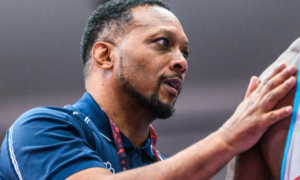
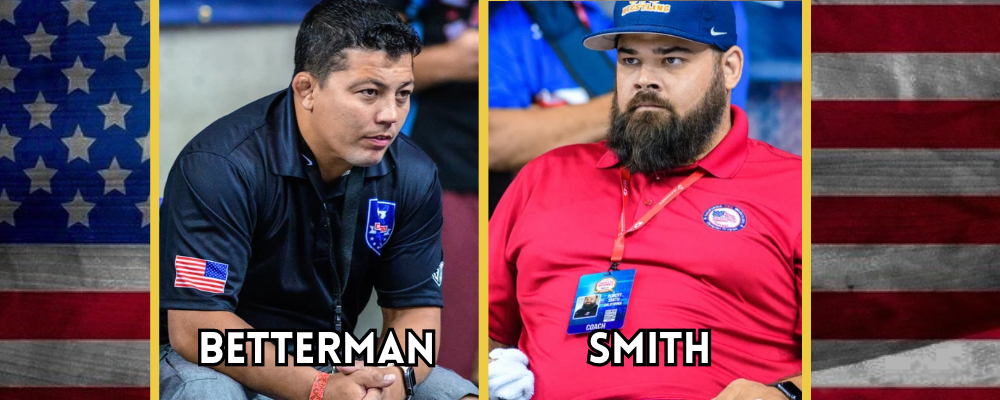
While Team USA staff at World-level events are often infused with athletes’ “personal coaches”, the national governing body each year still assigns two (or one) coaches to represent the organization. For ’26, those two gentlemen are Joe Betterman and Robby Smith. Betterman — a multi-time World Team member, National champ, and one of his generation’s best competitors — has in retirement become a highly-influential age-group coaching figure. Along with running his club Betterman Elite in-tow with his wife Deanna Rix, Betterman is also the state chairman for Colorado USA Wrestling. In addition, he helped lead the ’25 U20 World Team that competed in Bulgaria.
Smith, a World bronze medalist in ’15 and an Olympian the next year, has likewise gained prominence as a coach in the United States. In ’24, Smith was on the staff for the U20 World Team that produced three medalists; he has coached at the age-group continental championships, as well; and is the head assistant for the west coast’s flagship Greco-Roman program known as the Community Youth Center in Concord, California that has, for decades, developed an immense pipeline of Senior talent.

With the tournament now under a week away (and the final prep camp for the U23 World Team taking place this week in Colorado Springs), both Betterman and Smith spoke regarding their roles at the U23 World Championships and how they hope to help the roster prepare for the type of situations that they may encounter whilst competing at home.
2026 USA U23 World Team Coaches
Joe Betterman & Robby Smith
5PM: Having coached in World Championships before for U20, how might your approach differ this time being it’s U23?
Joe Betterman: I don’t know if it’s much different. I’m still doing things the same, especially since it is here in Las Vegas. I don’t think that we’re changing much. It’s all about development, right? We’re trying to develop these athletes to win Senior World and Olympic medals, and that is including the athletes on this roster who are already on the Senior Team. But I don’t think that we’re changing much other than to elevate and highlight whatever the athletes might need from us. We want to give them the knowledge that Robby and I have from having ourselves competed on the World level. We want to give them some of the knowledge that we have so that they can compete well.
Robby Smith: I don’t really think that I am going to change my approach much. Some of the athletes who were on the U20 World Team when I coached are on this U23 Team. I only know one way to coach, and I coach everyone the same way. It doesn’t matter if you’re five-years-old or an Olympian, I am going to try to coach you the same way. For me, it is about giving our best effort so that these guys can achieve their goals and dreams for this year, to get on that podium or to win that title. I look forward to being a part of this and part of Team USA.
Knowing what it is like to represent our country at home at a World Championships is something that I bring to the table because I got to do that in 2015. And in 2008, I also competed at the Thomas & Mack Center for the Olympic Trials. I am just going to share my knowledge, and whatever they need I’m here to help them. That is what I’m looking forward to, and that’s how I am going to coach this Team.
5PM: There are a few athletes on this Team whom you know well, and there are a few you might not know quite as well. If an athlete who you don’t know real well comes to you at the tournament looking for insights and advice, how do you handle it?
Smith: I give them knowledge the best I can. I have been in situations when I have coached athletes at tournaments who I had not coached before, especially with Team California. This will be third US roster that I’m coaching. I got to coach the U20 Pan-Ams in Chile and the U20 Worlds in Spain. In each situation, there are wrestlers you might not know well so it is about making them understand, Hey, I’m here to help, and things went pretty well on those last two trips. It is about giving the wrestlers everything that they need, giving them the best advice possible. This year is going to be unique because there are so many coaches who are going to be there between personal coaches and USA Wrestling staff. Like at that World Championships in 2015, everybody was there. I had one of the best experiences as an athlete I ever had because whenever I needed anything, there were people to help and it was very special to me. I want to be there this time to help our athletes in this way.
Also, it is about knowing when to back off a little bit if there is a crowd. When wrestlers are winning matches at home, people like to crowd around them and give them extra attention. You kind of have to approach that like when a pitcher is throwing a no-hitter or perfect game — try to give them some space. It’s 0kay to be around them, but don’t talk about the no-hitter or the perfect game. Instead, act like this is a normal thing. Act like you’ve been there before.
That is the experience that I’ve had, that is the experience we had at the U20 World Championships. We had two guys make the finals and we walked out of that tournament with three medalists. I’ve been around it as an athlete and now I’ve been around it as a coach. It is helping those athletes who are competing. Even if I don’t know them too well, I want them to know that if they ask me for help, I am going to do the best that I can. That’s my job at this tournament.
Betterman: I think that there are only one or two athletes on this roster who I haven’t worked with before, but the biggest thing for me is coming back to the fundamentals, the fundamentals of Greco. Bringing it back to that level because it is easiest to understand. To win at the highest level, it is not about hitting the craziest moves. It’s about sticking to the basics. It doesn’t matter if it’s men or women’s freestyle or the NCAA, it is about being able to rely on the fundamentals and sticking to the basics. You bring it back down to the basics for these athletes and then build it back up with them.
5PM: Wrestling a big tournament like this at home seems like a big benefit, but there could also be some distractions and potential stresses that aren’t there when you’re overseas competing. What would you tell the athletes so that they can focus and are less vulnerable to the extras involved with wrestling in a Worlds at home? I’m thinking of guys getting pulled away or answering too many questions from too many people, so forth.
Betterman: Obviously, wrestling in the US at a Worlds is exciting. But there can be a ton of pressure. I think Robby can speak to this, as well, because he has wrestled in a World Championships at home. I think the biggest thing is that it’s a stepping stone to what we’re trying to do, which is win Olympic medals here in the US. Having the tournament here can get some of those jitters out. Athletes might feel a little bit more pressure. The tournament is more accessible to parents and fans, and there can be pressure with that.
But like I said, this is kind of like our mulligan here to get ready for the Senior Worlds here next year and then the Olympics in 2028. The biggest thing that I can help these athletes with is keeping them calm, and helping them stick with their game plans that we put in place. We do not want them to feel nervous wrestling on this stage at home. We don’t have to deal with time zone changes and stuff like that; but at the end of the day, I know that they might feel more pressure being that the tournament is here in the US.
Smith: The difference between competing at home and competing overseas is that at home you don’t have to worry about the travel, the lodging, the food, or the acclimation. They don’t have to worry about any of that, which is really awesome. You feel great from the start, and this last week of preparation going into the tournament is huge because of the lack of travel. You don’t want them to overdo it this last week, you want them to feel fresh, ready to roll, and ready to compete. That’s what I remember from 2015. I was so dialed-in for that tournament, which in turn helped me feel very confident in myself. That is what I want these guys to have, confidence.
And that’s the next thing, which is the pressure that can be brought upon you by competing in your own country. I was blessed to be on a great Team in 2015. Everyone was super-energized and we knew the goal. We wanted to qualify as many weights as we could for the Olympics, and everyone was pumped and ready to go. That is the energy this U23 Team needs to have — no pressure. No pressure at all. You’re at home. Put on a show for the home crowd and show them what Greco-Roman wrestling is all about. If we can have these young men do that, this tournament for them is going to be so smooth and very enjoyable. If the weight at any time begins to feel heavy for them, then that is one the coaching staff to keep it light and reduce the pressure.
When it was us in 2015, we were stuck in the South Point hotel for a week and a half before the tournament. These guys aren’t. They are in Colorado Springs preparing, having good food, living the good life. We want to make it a good atmosphere and keep it one for them. I’m really excited to be around the boys and help them get ready. The pressure? It’s what you put on yourself. Give the pressure away and go out there to compete to the best of your abilities. If we can do that, I think that this Team can succeed at the World Championships.
5PM: When it comes to this last phase of preparation for the U23 World Team, how would you want them to take advantage of the fact that they don’t have to travel as the tournament comes closer?
Smith: To get on a plane for 12 to 16 hours, and then go compete in a different country that you don’t know… Plus, when you get there, you’re tired… I mean, enjoy this, because it doesn’t happen often. Plus, look at this: these young men have a Worlds this year, the Senior Worlds are here next year, and then the Olympics. That is three tournaments in your own country. Three tournaments they don’t have to travel to, and they are the three biggest tournaments of their lives. That is huge, and it is also where this experience can play a role for them later on.
This is such a blessing. So, ignore the noise, the distractions, whatever. Understand that this is an amazing opportunity and take advantage of it. Don’t let is pass you by, and don’t let your brain get in the way. Ignore the brain and just go out and enjoy this. I had this opportunity to wrestle at home and it was the best tournament I ever wrestled. If it had been the worst, would that change my mentality? Probably (laughs). But no, I want these guys to understand that this is an amazing opportunity that they can do together. And not only that, they may have the chance to do it three years in a row and that is pretty awesome.
Betterman: It’s crunch time, right? We’re not going to change too much other than build off of the techniques that they already have. We might specialize a little more in par terre defense. It doesn’t always do us a favor to get put down first. We want to be able to get on top first and get a turn. With these athletes, we want to tighten up their game a little bit.
We know who some of their opponents are because the entry list is out. We will be able to watch some video to see what their opponents might be good at. We can prepare that way but, you know, it is small things. Stick to the fundamentals, work on par terre defense and offense, and stay solid on our feet so that we can either score first, or get on top first.
5PM: There is not a lot of time between periods to coach an athlete, and how you do that might depend on what the scoreboard says or what the situation is. How do you communicate between periods at a World Championships?
Joe Betterman: With two coaches being in the corner — you have personal coaches, the selected coaches, and National Team staff is there, as well — building these athletes up and being positive for them in the corner is important. The second chair is looking for things that might get missed, and I know that the first chair is also looking for those things. We might have to adapt our styles a little.
For example, let’s say a two-on-one isn’t working but the opponent is weak on the underhook side, in which case we’d want them to look for underhooks. We want to be able to identify openings for the athletes that will help them have better opportunities to score and give them an advantage. Let’s call it :25, or even :20 if they start calling the wrestlers back to the mat early, we want to be able to communicate small changes quickly so that these athletes can adapt and be successful.
Robby Smith: It’s not a lot of words. It is very short. It is positivity, even when we’re losing. Positivity when you’re behind can go a long way. It is also a time for them to reset before they go back out for the second period. You say, Don’t worry. You’re down on points but don’t worry. Just regroup. We have him where we want him now. He’s tired… You want to get their minds to be thinking positively. If the athlete is winning, then be reassuring: Beautiful job, this is right where we need to be. Keep moving your feet a little more. Just small details. They all know how to wrestle and they are going to wrestle their match. It is just small details to get these athletes to keep them rolling.
That’s how I do it. If you’ve ever heard me coach, I am very positive. I try to stay away from the negative. I’m also a very passionate coach. I actually learned a lot from one of my athletes who I was coaching at the US Open. He was like, Too much, too much. So I said, “Okay, sorry. You need to move your feet. You’re not moving your feet.” And that was it. Those are the relationships that I like to build and, again, keep it positive, and make sure that they understand the circumstances. It does not make a difference to me whether it’s the World Championships or a weekend tournament at the Community Youth Center in Concord, California and I’m coaching a five-year-old. I’m going to coach them the same way. I don’t really change my ways. I just look forward to being on this stage with these guys. At this tournament, I am going to be a second chair. I’ll have their water ready and be there to encourage them through their matches.

SUBSCRIBE TO THE FIVE POINT MOVE PODCAST
iTunes | Stitcher | Spreaker | Google Play Music