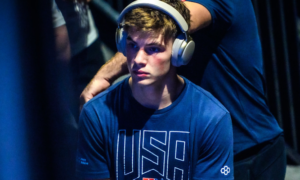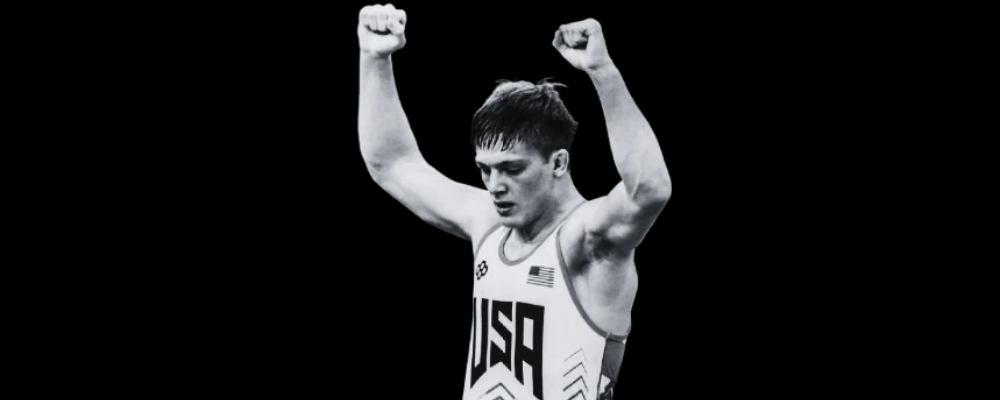
You could glance at the calendar and figure out how many days it has been since Aidan Squier (87 kg, NMU/NTS) shockwaved his way to bronze at the U20 World Championships in Slovakia. So it’s like, why go through the trouble to count? We know that when Squier did what he did — which was come back hardcore in the biggest tournament of his young life thus far — the weather was mainly hot, hazy, and humid, and these days the leaves on the sidewalk make crunching noises under your feet. Pretty simple.
What is also simple? Or even simpler? Tracking Squier’s progression as a top Greco-Roman athlete. Easy to follow. “Normal” American wrestling people who get all charged up over Fargo might remember Squier placing 2nd at the Junior Nationals in 2024. But for those who are either ardent observers of legitimate Greco-Roman in the United States, or are themselves somehow or another directly involved, they recall the winter of ’22. That was when Squier’s international career first began to materialize. And over the course of the next few years, the pseudo-displaced Wisconsinite piled up a bunch of overseas hardware — which is a big deal around these parts because, as many (but not most) understand, Greco competition in other countries presents a decidedly different array of challenges when compared to domestic. Young wrestlers who learn Greco-Roman only through an American lens are receiving an incomplete education, at best, not a thorough or authentic one.
But there was Squier, medal after medal, gold after gold, all of them earned far, far away from home. Few noticed. Just how it goes. Didn’t matter. Squier kept training and learning, learning and training. Domestically, he was doing alright. There was the aforementioned Fargo Junior final. A season later, Squier made the finals of the ’25 U20 World Team Trials and it was pretty much heartbreak city for the then-18-year-old as he had won the first match of his best-of-three series before dropping the next two. No one who has taken this ride with him even blinked. He was supposed to struggle here and there. It’s always weird how the USA age-groupers who specialize in overseas Greco have to adapt to how the sport is contested within the borders of their own country. Alas, such is a necessary hurdle to clear if making World Teams is an objective.

By the time Squier started his freshman year at Northern Michigan University in the late-summer of ’25, he was a prized prospect whose skill-set was expanding in conjunction with his confidence. Lucas Steldt had done his part in shaping Squier’s technical foundation in the three years prior and passed the baton to NMU head coach Andy Bisek. Because, that has been the pipeline. Squier as a frosh was already an established commodity, for sure, but the difference two semesters on-campus made for him was unmistakable.
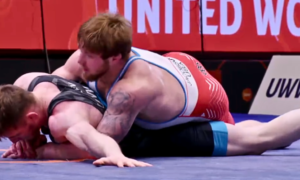
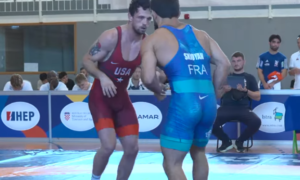
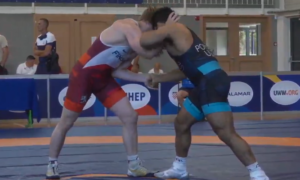
Everyone knows what happened next. And, yes, the focal point is of course the World medal, but the “how” matters with Squier. Okay, you acknowledge the ability, the teenage years loving and training Greco, going to Northern, working out with Payton Jacobson (87 kg, NYAC/NTS) on a near-daily basis — all of it. But ability, passion, a two-time World bronze medalist as a coach, and an Olympian as a training partner do not equate to how Squier persevered in Britislava. Those items helped, but they were not how. The how, in this case, was a mix between uncommon heart, courage, and conviction that you’d like to believe is inside of every elite wrestler…but just isn’t. Squier was defeated in the first World Championships match of his career by Taizo Yoshida (JPN), who was a Senior World medalist in ’25. Yoshida made the final, which wasn’t surprising, and so Squier had another potential run available in repechage. In his second-to-last match of the tournament (i.e., the one before the bronze round) Squier trailed returning U20 World champ Luka Kochalidze (GEO) 4-1 with less than :10 on the clock and daringly executed a high dive off the boundary for the win. It was one of the most thrilling finishes to a match featuring an American in recent memory, to say the least.
And if all that weren’t enough, Squier was behind Gabriel Stan (ROU) 6-0 in the second period with bronze on the line. A four-point bodylock closed the gap, passivity on Stan availed a chance from top par terre, and Squier did what the special types usually do — he took advantage, scored a point, and held his ground until it was safe for him to raise his arms in triumph.
These are just notes. Background. An intro for those who might not be aware. The details, the inside stuff to Squier’s story, paint a much fuller picture of what kind of athlete he is and, more importantly, the integrity of his character. The furthest thing from an attention-seeker, sort of like his NMU coach, Squier is not heard from too often. That does not mean he is shy. “Reserved” is a more appropriate word. He wants to talk about these things. He wants to share what it is about this whole endeavor that makes it all worthwhile, and the way that he sees his place in it. But you have to ask. If it is about the sport and his adventures in it, he is an open book with the still-shiny World medal merely serving as an opening chapter.
5PM Interview with Aidan Squier
5PM: What was your initial introduction to Greco-Roman wrestling?
Aidan Squier: I started Greco during my third year of wrestling, so I was about eight-years-old. I did all three styles and was always wrestling. In the summer, I would do freestyle and Greco. I fell in love with Greco basically from the start. I had fun throwing people. I loved doing it. Then we moved out to Connecticut when I was 11, I continued doing all three styles, but I had begun to want to do only Greco. But I was told by coaches that I couldn’t, that I would have to go to college and wrestle folkstyle. Eventually, I went on a trip with Omar Feliciano — who would become my coach when my first coach left — and he gave me that opportunity to focus on Greco.
I had been connected to Lucas (Steldt) for a bit and was doing the HGP camps with him. I saw the guys who had come up under him doing only Greco, so I knew it was a possibility, and so Omar giving me the avenue to do that was really awesome. Then I moved out to Wisconsin and started wrestling Greco full-time.
5PM: Prior to returning to Wisconsin, how were you able to get meaningful practices in with training partners while you were still back east? Because I imagine that there were not a bunch of Greco partners around.
AS: There were actually zero Greco people around me. Most of my practices would just be me and Omar and we would hand-fight for an hour and just figure things out. We would go to the sauna and just watch wrestling. That was pretty much my training. I would do other workouts at the school; but when I was just training Greco, it would mainly just be Omar and I. I would do matches with other coaches he had there, such as Gabriel Roman. But other than that, I didn’t have any Greco partners out there.
5PM: Just to backtrack, you said you had been connected to Lucas. How did that originally come about?
AS: I think that it was because of Aeoden Sinclair since he would also do the High Performance Greco minicamps that Lucas held. So, I would fly out to Wisconsin and ride up with Aeoden Sinclair to the camps. I’m pretty sure that’s how I got connected to Lucas. I was 12, so it was my parents who handled all of that at the time but I’m pretty sure it was the Sinclairs how I got connected to Lucas. They told my family about it.
5PM: As you mentioned, Lucas had established himself as a coach who develops young athletes to reach a higher level. How did you take to his methods and training style once he really began coaching you?
AS: My favorite thing about the way Lucas teaches is that he understands that Greco is always adapting, how there are always things changing in the sport. Lucas has never been the type of guy who has one way of doing something and then thinks that will always be the only way to do it. He is always keeping up-to-date with what is meta in the Greco realm. There are some clubs where they have been showing the same thing for 50 years, but we were always students of the sport. When we would go overseas, we would constantly learn new things and apply them. It was always a learning process when it came to the sport instead of just repeating techniques from 40 years ago.
5PM: The way that you started popping up on the radar is because of all of the overseas tournaments you were competing in, and competing very well in them. I don’t know if I’m wrong, but it seems like you won most of them and medaled at all of them except for one.
AS: I think so.
5PM: How did performing well in all of these overseas events track with how you viewed your own progress as you were training?
Aidan Squier: When I started going overseas and having success, it gave me the realization that the goals I had set for myself when I was eight-years-old were goals that I could achieve. Because, it seems like a dream when you’re young and want to be an Olympic or World Champion. But when you go overseas and start seeing success, it puts it as more of an achievable goal rather than just a dream. That switch is such a motivator, especially when you’re dealing with any kind of burnout or down times. Knowing that the goals you had set for yourself when you were younger are not as far off as it may have once seemed motivates you to keep going and push through everything that is being thrown at you.
5PM: Since the majority of your Greco-Roman experience is actually international experience, how does that influence your perspective on domestic competition?
AS: The international way of wrestling Greco is so completely different from how it is wrestled in the United States. So, being able to have most of my experience, or at least a lot of it, stem from international wrestling, I feel like my knowledge of Greco is much more expansive compared to how people from the United States see Greco. People see it domestically as way more simple than it really is, whereas international guys have picked apart every single piece of Greco wrestling that there is. And there is just so much more to it than is perceived in the United States.
In freestyle/folkstyle wrestling, your reactions, your muscle memory, is to get your hips away when a guy is attacking you. It is to back your hips out so a guy can’t grab your legs. That is literally the opposite reaction that you want to have in Greco. You need to have your hips in. If some dude is trying to throw you and you back your hips away, you’re going to get planted. But if you have your hips in, and you’re in the fight, then you can defend. That is such a roadblock for US to get over because it has been ingrained in them to get their hips out when a guy is attacking them. That is part of why I think that we don’t succeed, because it is a muscle memory that is so ingrained. And if you can’t get over that, it is hard to find success.
Offensively and defensively, you need to have your hips in. When you wrestle internationally, those guys have it ingrained in them to have their hips in. It is such a fundamental part of wrestling that is completely different. Greco-Roman wrestling is just a completely different sport than freestyle or folkstyle. That I think is the main difference and contributing factor to how the wrestling works in the different styles.
5PM: When there are those at Northern who are starting to break into this and don’t have the international experience or understanding that you do, how do you exemplify this for them so that they know what to expect?
AS: I’m always looking around at practice, especially at the new guys who come in, and I like to help them whenever I can. I pretty much try to paint the picture clearly of how a move they might be doing is not only wrong, but also how the fundamentals of what they are doing are applied throughout all of Greco. If a guy is doing a specific move wrong, I’m not going to just tell him to try to do it a different way. I like to also show him how what he is doing is affecting all of his wrestling. I think that I have helped some of these younger guys understand more the fundamentals of Greco rather than just specific techniques.
5PM: Given that you trained under Lucas and had that run of overseas tournament successes, was it always a foregone conclusion that your were going to go to NMU or did you consider any other options?
AS: No, pretty much as soon as I started training with Lucas, my mind was set on going to Northern Michigan. I didn’t have really any other options.
5PM: You went from Lucas, who is certainly more of an overt personality, to being coached by Andy. Andy is not necessarily a mute, but he has a different style of communication. What about Andy’s style works for you now that he is your coach?
AS: I think that Andy has a good way of knowing what an athlete needs because every athlete is going to need different things according to what they are good at and what they need to work on. Andy is definitely good at figuring out where an athlete’s weaknesses are. For me, I have always been more technically-strong rather than just being like an animal. A lot of that is what he had me working on, by wrestling him and by wrestling Payton, taking me to deep waters. That is what he had me work on, being more aggressive and meaner out there instead of just relying on my technique. I think that he was able, from the start, to recognize that is what I needed and it has really helped me, especially when it came to me going to Slovakia and earning a medal.
5PM: You mentioned Payton, who is of course a leader in your room, even a coach in your room. I’m sure that he is such a huge asset for you. How has Payton shaped you so far?
Aidan Squier: He has been a great partner to have. When he goes overseas, he always comes back and shows stuff that he has learned. He has been a huge motivator for me and is always pushing me in the room. He has really been just a fantastic partner. I love drilling with him. We’ll just brainstorm ideas out of certain positions. Greco is such an art form for us and it is so fun to train with him. He has really helped me come a long way since I started school here.
5PM: This year, you focused on U20.
AS: Yeah.
5PM: Leading to Las Vegas in April, there were some of us who expected you to enter the Senior division, as well. Was there any point when you were considering entering both the U20 and Senior Trials?
AS: I was considering doing both even during the day I was wrestling U20. I never decided to do only U20. During my second match of the U20 tournament, I hurt the first rib under my collarbone really badly. In between matches, I would lay down and be unable to pick my head up. I was running on straight adrenaline for my next matches. I wasn’t even sure if I would be able to wrestle the final. I was on the phone with my dad nearly in tears because I wasn’t sure if I would be able to go out there and wrestle.
So, the decision to not wrestle Seniors was solely because I was in so much pain. My shoulder… I have been dealing with shoulder issues for a year-and-a-half now. Then in the tournament I went to throw a dude and he landed on my chest, and just destroyed my first rib. But on that day, I was still planning to, still had it in my mind that I was going to wrestle Seniors, but I ended up pulling out of it just because of how much pain I was in.
5PM: How long was it before you were good to begin training for the U20 Worlds?
AS: I was off the mat for maybe two weeks and then I had to go to Croatia for the camp. I was still dealing with that rib while I was out there but just doing my best to push through that. And then while I was in Croatia, my shoulder was just getting absolutely destroyed (laughs). The training for Worlds was really brutal. I was in a lot of pain the entire time. Back at NMU during the summer – and we were training in the basketball gym or the volleyball gym – it was about doing as much as I could before my shoulder couldn’t take it anymore. Then we would back off. It was just brutal, trying to deal with that. It was really frustrating because it was like, This is my first World Team ever, and I want to do the best that I can, but I wasn’t able to train as much as I would have liked to.
5PM: How did those around you – be them your coaches or training partners – help prepare you for the tournament?
AS: A lot of it was the reassurance that I have all the capabilities to medal at the Worlds. I didn’t need to learn anything because the capability was already there. That reassurance kept me from worrying, Oh, I’m not training enough. A lot of our training was focused on my cardio and muscular endurance, and being able to push through all six minutes of each match. It wasn’t like, We have to work on one specific thing. No, the reassurance was that I have the capabilities, I have the technique, and so the focus was on me being in the best shape possible while trying to keep my shoulder as healthy as it could be.
5PM: What about pertaining to your approach to competition? How were you coached on that aspect for the Worlds?
AS: I’ve dealt with sports anxiety and it hasn’t been easy. I’ve dealt with it my whole career and it is always a tough battle to overcome the sports anxiety – but I wasn’t really that nervous for the World Championships. It’s a big title. “Worlds” is a big title, but it was actually nothing new to me. With all of the traveling and international stuff that I’ve done, I knew so many of the guys in my bracket, and had wrestled with so many of them. It was nothing out of the ordinary for me.
I was pretty comfortable with going out and wrestling those guys because a lot of them I had wrestled before. I know the international style of Greco and so my mental state was just excitement. I was so excited to be able to show what I can do, and show that I belonged on the World stage.
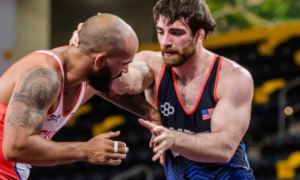
5PM: You hit a setback right away in your first match against Japan (Taizo Yoshida), who was a Senior medalist last year and obviously a big name in the bracket. What was your mindset like throughout that first day, aside from just hoping that Yoshida would make it to the final?
Aidan Squier: Obviously, I was frustrated with myself. I think that I could have done better. I think that he just overwhelmed me and that is where it really went downhill. But I knew that I wasn’t done at that tournament. I was very confident that he was going to make the finals, and I knew that I really wanted to get back out there. I didn’t want that to be it for me. I had come a long way to get there.
Really, my mind was just focused on giving everything that I had in the tournament because my goals are way more than just making a Team and going 0-1 or 0-2. I knew that it wasn’t going to be easy, but I just had to keep pushing and keep grinding through the tournament. It was a setback, but also a wake-up for me. It was, This is what this is going to be like. It’s not an easy road to get a medal. These guys are good, I’m good, and it’s going to be a grind to see who comes out on top.
5PM: You get the first win in the repechage against Ukraine (Vladyslav Solodchuk) and so you saw how the repechage bracket was going to unfold. Did not only winning, but also how you won, against Ukraine re-establish your confidence?
AS: Yeah, getting that win under my belt definitely felt good. Getting more wrestling in general… Getting a win like that where it felt like I was in control the whole time – it wasn’t like a 1-1 match or something like that – really gave me a sense that I belonged there. Because, I knew that none of those guys were bad, right? So it showed that I could beat anyone out there.
5PM: The match right before bronze against Georgia (Luka Kochalidze). It’s all of the circumstances. He was the returning champ, there are :08 left. You’re not like 5’7. You’re tall. You lower your level for a high dive and it’s four off the edge. And you were not down by two, either, you were down by three. It was the most amazing finish we’ve seen in a long time in that kind of spot. What was your process? I don’t know if it was that you were limited in options, I don’t know what you saw beforehand… What was your processing in that moment down by three with :08 left?
AS: This is actually my favorite match to talk about because that high dive… I love to hit a high dive here and there. I’ve hit it many times. So, I saw this high dive in the first period. Pretty early in the match, I saw that it might be there and was keeping that in the back of my mind the whole time. A high dive is the kind of move where if you hit it and are not successful, you’re probably not going to get it again. You’re not going to get a chance because now the other guy knows that it is in your repertoire.
So I kept this high dive in my back pocket, and I kept seeing it was possible that it would be there. When it came down to it, I looked at the clock and saw :10. I knew it was now or never for the high dive attempt. I noticed throughout the match that the more tired he got, the more his legs straightened. That made the high dive more of a possibility. I just saved it till the end because I didn’t want to try it too early, not get it, and plus he was really good at being defensive and not being scored-on. I had wrestled him in Croatia during the camp. The Georgians were there and I knew that he was a solid guy and not easy to score against on his feet. I kept that high dive in my back pocket, looked on the clock and saw :10 left, and I knew that it was either that move or I was going home. So I hit it with everything that I could and just ran my feet until his back hit the mat.
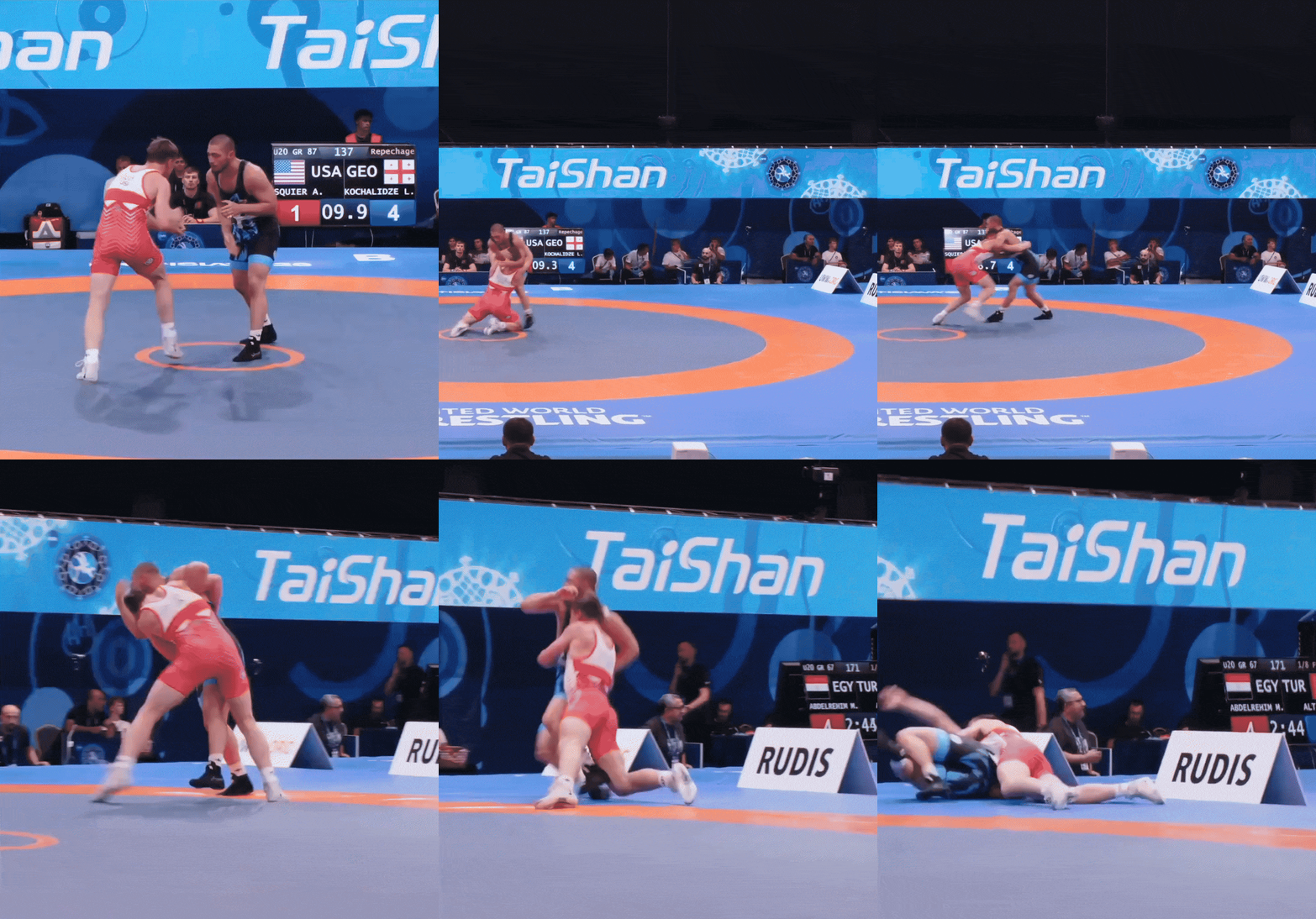
CLUTCH: Down by a score of 4-1, Squier (red) darted in on returning champion Luka Kochalidze of Georgia with under :10 left in his penultimate match at the 2026 U20 Worlds.
5PM: Do you understand what kind of competitive maturity it takes to see something like that in the first period and have the calmness and patience to wait until you really needed it?
Aidan Squier: Yeah, it’s not easy (laughs). It’s tempting when you see it there, but I couldn’t waste it. You can’t waste a move like that.
5PM: Then the bronze round and here is another comeback situation because you were down 6-0 going into the second period. Was there anything noteworthy about which you were reminded between periods with Bisek in the corner?
AS: Nothing specific. No specific words were noteworthy. It was just the sense of, The match isn’t over. It’s 6-0, but there are still three minutes left. And it wasn’t like I hadn’t made a comeback before. The previous match I was behind and got it done, so it wasn’t an unfamiliar spot to be in. The consensus during the break was there was still time left and for me to keep doing what I do, and to keep wrestling.
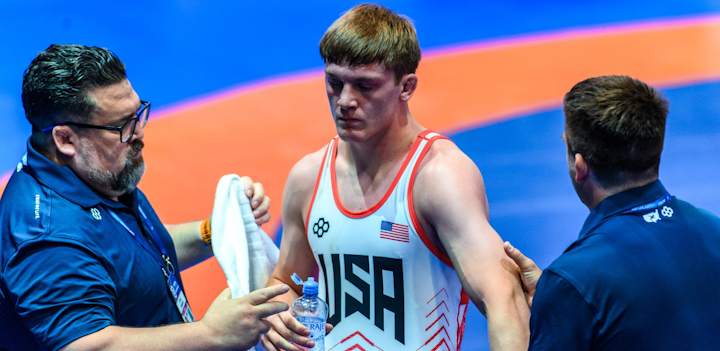
Squier flanked by coaches Zac Dominguez (left) and Andy Bisek (right) between periods of the 87 kg bronze-medal match at the 2026 U20 World Championships. (Photo: Tony Rotundo)
5PM: Your first gash here was a bodylock. The position seemed to mature organically. Did he feel any different to you in the second period compared to the first?
Aidan Squier: Definitely. He was gunning for those last two points to end the match, and I think that is why he rushed into that bodylock. That was more his initiation than it was mine. I think that he was just wrestling to finish the match and that led him to doing stupid things, like giving me opportunities. I went out in that second period and just stayed true to myself. I just wrestled the way that I wrestle and the position opened up for me. I think that he just went into it trying to get the match over with. And that’s what led to his downfall.
5PM: He then winds up getting put down in par terre and now you’ve got to score again. You know what you like to do from top, but was there any second-guessing? You were just going to your go-to there, correct?
AS: Yeah, I was going for the lift.
5PM: You had to work to get that lift. Were you concerned about just yanking him up and getting whatever you could get there? Or were you looking for four?
AS: In the heat of the moment, I wasn’t thinking about how the passivity gave me one point (laughs). So, in my mind, I thought I needed two points. I was throwing him to get two or four, I wasn’t going for one. Obviously, ideally I wanted four but I was hoping to at least get a correct throw and tie it up. At first when I got up after scoring one point, I was like, I need to go get another point; but then I looked and since I had gotten a point for the passivity, I was up. If I had known, if I had been thinking about that previously, I probably would have realized, Just throw him out of bounds because any score gives me the lead. But that’s pretty much what I did, anyway, so it worked out for me. I think throwing it for two or four intentionally was probably a better mindset than thinking, Oh, I just need one.
5PM: It is very important to know how to close out a match. One thing that Americans usually have is that they are in better condition than everyone else. There wasn’t a ton of time left, but you were in position to hold him off. Either way, it was time to chew the clock. What was going through your mind? Because he was fighting, he didn’t just fade away. What was your approach?
AS: My approach was to focus on my own position. I knew that if I did that, I’d be okay. The amount of times that I’ve trained being down by one and needing to score… Sometimes we’ll use the little circles on the mat and you need to get a push-out while the other guy is trying to stay in the middle. The amount of times I have trained with Lucas Steldt and Andy Bisek this exact scenario? As nerve-wracking as it is to be in that situation – like leading on criteria in a World medal match – it was no different than anything I had already trained. So I knew that if I just stayed true to myself that I was going to be okay. It was something that I trained millions of times. I knew to just hold center and not run away and be passive.
5PM: You are reputedly more of a reserved guy, a quiet kind of guy. You’ve pictured moments like this before. What was it like celebrating that you had earned a World medal?
AS: It was really incredible. It was all that I worked towards. I mean, it’s what I dedicated my life to. It was just awesome, everyone around me being so happy for me, my parents being able to be there and watch me… It was an awesome moment. It felt amazing.
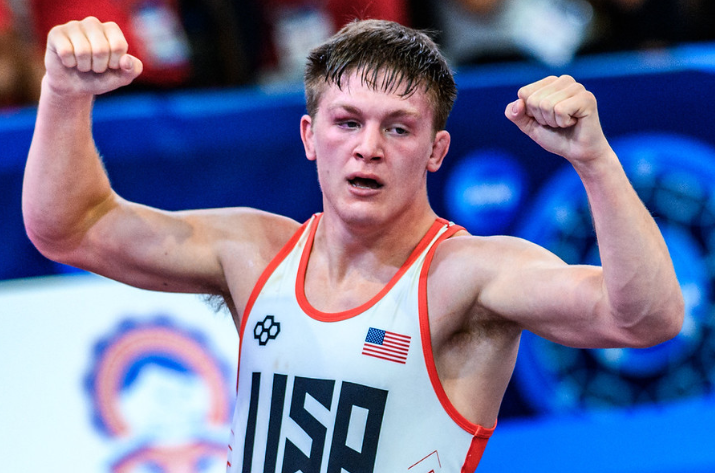
Squier defeated Gabriel Stan via criteria 6-6 to come away with bronze at the U20 World Championships. Squier trailed Stan 6-0 entering the second period before staging the impressive comeback. (Photo: Tony Rotundo)
5PM: You said before that you had familiarity with guys in your bracket. If you have re-watched the tournament, what have been your takeaways as far as learning from it?
Aidan Squier: Especially the Japan match, I have a habit of wrestling to the other guy’s style or tempo. That is where I went wrong against Japan. I was just trying to keep up with him and wrestle his match. I think that is something I’ve worked on and it is something that I need to work on more, which is making guys wrestle me more than I wrestle them. I mean, you can definitely see it in that Japan match. I was definitely wrestling his match and it was not to my benefit, that’s for sure.
5PM: You have been practicing since the tournament?
AS: Since Worlds, I have been very limited because my main focus is on healing my body. I have been practicing, but with pretty strict limitations. I got PRP (platelet rich plasma therapy) and you’re supposed to rest for a bit after that.
5PM: We don’t know right now when you are going to be back at full speed. But considering where we are in the quad, ideally what would be your plans this season? Plus, you’re aging out of U20.
AS: I was really hoping to wrestle at the Bill Farrell Memorial coming up but it looks like that is probably not going to happen; and we don’t have any overseas trips planned yet. But really, I am just setting my mind on getting as healthy as I can and making the U23 Team next year.
5PM: Both through the summer and even more recently, how have you dealt with the news that the university has made overtures towards discontinuing the program?
Aiden Squier: Obviously, it really is a shame that they have discussed getting rid of the program. But the program being here at NMU doesn’t change where my goals are. Their desire to cut the program doesn’t do anything to my desire to become an Olympic Champion. Keeping that in mind allows me to put the issue out of my mind and realize that I still need to go out and train to win a World medal. It really just comes down to that my goals are still the same as before. Wherever I am training, it is going to be for Olympic and World medals.

SUBSCRIBE TO THE FIVE POINT MOVE PODCAST
iTunes | Stitcher | Spreaker | Google Play Music