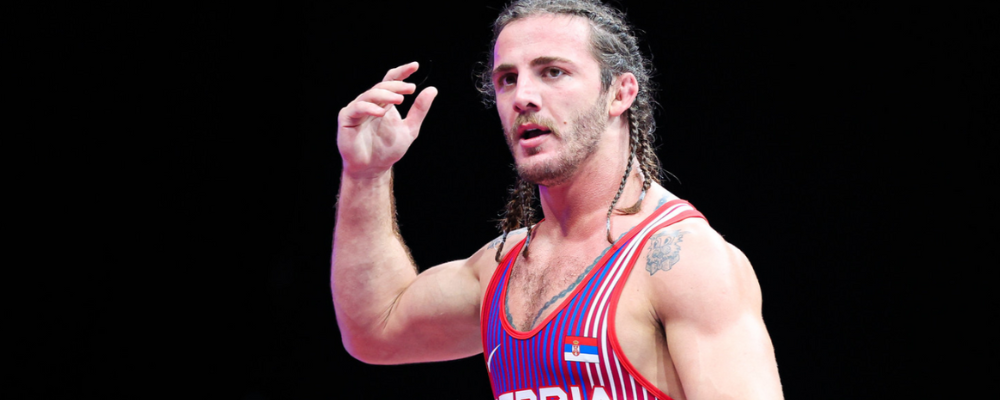
Last week, the Court of Arbitration for Sport (CAS) upheld a retroactive ban imposed on Zurabi Datunashvili by its Anti-Doping Division, thereby eradicating all of the athlete’s results from May of 2021 through his last event in ’23 — a period of time which saw him earn an Olympic bronze and two World titles.

Datunashvili, 34, was a top middleweight contender (75-80 kg) for his native Georgia until 2020, when he moved to Serbia and began representing that nation in competition at 87 kg. Whilst on the Georgian team, Datunashvili had already amassed an impressive list of credentials highlighted by a pair of European Championships golds (’16, ’17) and two Olympic appearances (’12, ’16). But his results reached a new level after he defected to Serbia.
Along with having earned the aforementioned Olympic bronze (’21) and consecutive World golds (’21, ’22), as a member of Team Serbia, Datunashvili also:
- collected his third Euro title (’21).
- triumphed at both the Nikola Petrov Memorial and Ion Corneanu and Ladislau Simon Memorial ( in ’21 and ’22, respectively).
- and earned bronze at the Zagreb Grand Prix as well as the first (and to date, only) Individual World Cup (both events in ’20).
Since Datunashvili’s results ban is retroactive to May of ’21, his Euro title from that April of that year is still recognized, as well as are his medals from Petrov, Zagreb, and the IWC.

Datunashvili’s sanction arose from an attempt on his part to obscure testing procedures, first by using a substitute urine sample. An additional charge was later added for his having filmed a video to, presumably, justify missing an out-of-competition test.
Nevertheless, it is another instance of a troubling yet all-too-common occurrence in the sport of wrestling. Datunashvili is only the latest in a long line of athletes whose careers have been marred by doping violations. In this case, the aftermath is particularly bothersome because, prior to the sanctions, Datunashvili’s story was one of resurgence.
Though he had certainly established himself as a top-flight wrestler who had twice come close to earning a World medal by finishing 5th, the field surrounding him had begun to grow in formidability. Datunashvili had entered his late-20’s by the time his dissatisfaction with the Georgian federation became problematic enough for him to leave his home country; and with numerous promising young upper-weights starting to assert themselves, the competition in and around his weight range sufficiently increased. But it seemed that Datunashvili had received a new lease on life after joining the Serbian program. A capable and experienced combatant who was previously on the cusp of earning World hardware had not only managed to come away with an Olympic medal, but he would eventually secure back-to-back golds at the World Championships, as well. In ’23, the year in which he became subject to the aforementioned doping investigation, Datunashvili was, naturally, being discussed as one of the premier names who were expected to potentially contend for Olympic gold at Paris ’24.
Then, in short order, he was absent from competition and Serbia moved on rather seamlessly thanks to the presence of former Russian age-group star Aleksandar Komarov, who won the Euros at 87 kg in ’24, placed 8th at the Olympics later that year, and this past fall emerged victorious at the World Championships.
Medal Re-Allocation
Datunashvili’s medals from the ’20ne Olympics, ’21 WC, and ’22 WC have been re-allocated to the following athletes.
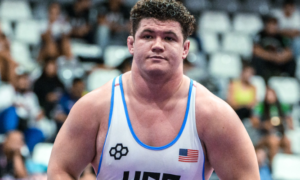
- ’20 Olympic bronze — Ivan Huklek (CRO) — first Croatian to earn an Olympic medal since Vlado Lisjak (gold, ’84); first Croatian Olympic bronze since Milan Nenadic (’72).
- ’21 World gold — Kiril Maskevych (UWW/BLR) — first Belarusian to win a World title since Alim Selimov (’11).
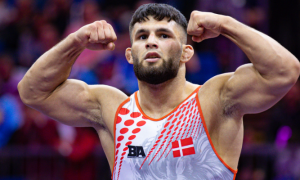
- ’22 World gold — Turpal Bisultanov (DEN) — first-ever Danish Greco-Roman World Champion.
Kayaalp
In the summer of ’24 — and just prior to the Paris Games — multiple-time World Champion/Olympic medalist Riza Kayaalp (130 kg, TUR) was himself on the wrong side of a doping sanction due to his having used Trimetazidine, which he was purportedly prescribed for tinnitus. Kayaalp claimed he had been experiencing “severe ringing in the ears, dizziness, and headaches”, and was under the care of a doctor at the time of his violation. The CAS subsequently handed down a 4-year ban on Kayaalp, which might have effectively ended his tremendous, Hall of Fame-worthy career.
However, last month the CAS reduced Kayaalp’s suspension from 48 month to 18 — meaning that he may return to competition soon after the New Year. Kayaalp, who turned 36 in October, was very much still a force with which to be reckoned at heavyweight before his suspension, and many fans were looking forward to the possibility of him once again clashing with Mijain Lopez in Paris. Lopez eventually won his historic 5th Olympic gold in Paris by defeating Yasmani Acost Fernandez (CHI) in the final.
Should Kayaalp make his way back onto the mat in ’26, he will have plenty of supporters who feel that an Olympic gold is still within his grasp, one of which being Turkiye’s federation president Taha Akgul, who said, “His fitness is still impressive. He never left the mat. With this decision, he’s free to compete again – and maybe, win the Olympic gold that has eluded him. Cuba’s Lopez has retired, and Rıza remains one of the biggest favorites.”


SUBSCRIBE TO THE FIVE POINT MOVE PODCAST
iTunes | Stitcher | Spreaker | Google Play Music