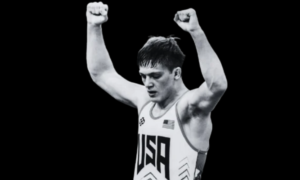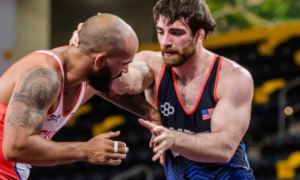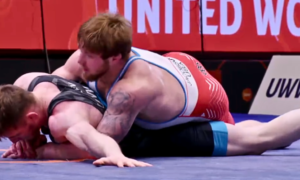
When Spencer Woods (Army/WCAP) suffered a torn knee this past winter, the complexion of his weight class, 87 kilograms, was immediately altered.

This season, Woods, 27, had been hard at work preparing to try and reclaim the #1 spot in the country’s consistently-best weight division. In December of 2023, the “Alaskan Assassin” clinched his third National title and, along with it, the opportunity to qualify 87 kg on behalf of the United States for the Paris Olympics. And he indeed got the job done, though the glow of that achievement did not last very long. Thanks to one of the most heroic and memorable US efforts in recent history, Woods defeated Cuban Daniel Gregorich Hechavarria at the Pan-Am Qualifier; but the sweet taste of that victory was replaced by the bitterness of his falling to Payton Jacobson (NYAC/NTS) in three matches less than two months later at the Olympic Trials. Then last April, Jacobson got past Woods in another tightly-contested third round at ’25 World Team selection.
Prospects for Woods were much improved heading into this season. He had remained sufficiently active and locked-in as January approached and, by all accounts, performed rather impressively at the winter camp held at the Olympic Training Center in January. This was not just good news for Woods, it was also a positive note for the National program. The general consensus is that, among all weight categories, 87 kg might be the closest to producing a medal for Team USA. Such a perception had been driven by Jacobson’s continued progression overseas in conjunction with Woods’ own competitive viability and the potential impact ’23 World Teamer Zac Braunagel (NYAC/Navy WC) is capable of delivering inside of the bracket. This trio of monsters were seen as 87’s “Big Three”, at least as far as ’26 was concerned. Therefore, when Woods’ ACL became compromised, the thought was that so too did the integrity of the 87 kg bracket for this year’s Trials.
Wrestlers (and their coaches) do not have the luxury of observing weight classes on a macro scale. For them, it is solely an objective endeavor. A top Greco-Roman athlete in the US might acknowledge a bracket’s perceived strength — but that does not necessarily mean they are rooting for the deepest, roughest road to making the Team. Their lone interest lies in advancing through each round and eventually winning the thing. If they smash everyone in their path without so much having slapped hands for a second period, so be it. However, the US is shooting for legitimate depth in each weight category because competitive distance between domestic athletes tends to not translate to international success.

The concept of depth is often conflated with quantity when the term should instead be associated with quality. The US program does not need 12 would-be killers in a bracket but they do require a minimum of three. Three guys who can either beat one another, or come reasonably close, or at least provide a hardcore problem for each other through six minutes of a match. This is why when Woods’ injury eliminated him from the bracket for ’26, it was deflating news on two accounts. First and foremost is the concern for the wrestler himself, his health, and general well-being. Woods is one of the most admired competitors in the country, and for good reason. He has developed into a ferocious yet effective upper-weight with World-level experience. His being forced to sit on the sidelines compels personal compassion. Secondly, and from a strictly competitive aspect, his removal from the 87 kg class instantly equated to a significantly-weaker ’26 Trials bracket. And everyone knew it.
Until Beka.
Enter Melelashvili
It might have been just a matter of time before ‘24 U23 World silver Beka Melelashvili (NYAC) waved goodbye to 82 and hello to 87 but it was not originally on his to-do list for this season. Melelashvili had intended to stay put at 82 until the Olympic year, which was a confounding situation in its own right, for there was little doubt that the cut to 82 had already begun to increasingly harm virtually every facet of his competitive profile. Melelashvili, as far as skeletal muscle is concerned, was huge for 82 with either little to no discernible physical leeway available from which more water could possibly be drained. Even at “walking around weight” between tournaments he was lean, which of course gave way to debilitating weight cuts when it was actually time to compete, and that resulted in a decline in performance capability.
Coincidentally, within the same time-frame that Woods’ knee got torqued out, Melelashvili found himself with a shoulder injury that was serious enough to call into question his status for the spring. In fact, the initial reports were that he would likely miss the Trials. But through rest and rehab, his prognosis 180’d. He was going to be fine, 82 kg for him was history, and 87 would be his landing spot both now and into the foreseeable future.
What This Means
The sting of Woods’ absence from 87 is somewhat abated by Melelashvili’s presence. “Somewhat” and not “totally” because Woods’ value to the weight division is unquantifiably high and as such his removal from it cannot simply be canceled out by the arrival of another top athlete. Moreover, and as discussed earlier, the 87 kg bracket for the US would certainly be better-served if both wrestlers were in the event to go along with Jacobson and Braunagel. But, for ‘26, Melelashvili’s entrance into the fray – a year or so earlier than originally anticipated, no less – is a net positive. It is a positive for Melelashvili, who now has more time to become accustomed to the weight class (though it is hard to imagine he requires a substantial adjustment period considering his size and talent), and it is a positive for the health of the bracket overall.
An additional yet interesting byproduct of Melelashvili now looming on the bottom side of the bracket is a potential semifinal showdown with Braunagel. Should this pairing come to fruition, it may present an equally suspenseful and kinetic clash of styles. Melelashvili is a human weapon from top par terre and fundamentally-sound defending from bottom PT – neither of which are particular strengths for Braunagel. But Braunagel can ignite a pace with which Melelashvili struggles, leading to possible on-the-feet scores, be them takedowns or step-outs. Conventional wisdom, for whatever that is even worth in a USA selection tournament, suggests that if Braunagel can defend from bottom, he may hold a significant advantage. Consequently, if Melelashvili can score OTF, then Braungel might be in deep trouble.
The X-Factors
There are more in the pipeline but these four wrestlers are identified as possible candidates to wreck the bracket.
Ty Cunningham (NYACMWC) – “Turbo Ty” is up from 82 kg, where last year he came back from a second-round loss in the Trials (to Jesse Porter) to go the distance and finish 3rd. Cunningham has been a promising athlete for some years now, hovering between 82 and 77 (for the Olympic Team push in ‘24). He could have opted for 82 again this season but is making the smarter move for his future. Within the confines of his own stylistic expression of Greco-Roman wrestling, Cunningham is at least as versatile as any other American in this bracket. He is also a game and sharp competitor who can threaten with chain-scoring opportunities his contemporaries take for granted. Defense is the name of the game at 87, however, even more so than at 82. Cunningham is going to have to defend from bottom in order to make a splash. Surely he knows this.
Aidan Squier (NMU/NTS) – Not that young Mr. Squier can even think about abandoning defensive priorities, either, but in his case we are talking about a still-age-group-eligible prospect who wields more authentic skill than anyone else at 87 with the exception of Jacobson and Melelashvili. Squier might not be all the way quite there yet to challenge for the WT spot; that said, his progression indicates that he could be ready to deliver the boom by the ‘28 LA Trials. Last year at 82, his struggles were mainly limited to items surrounding the balance between competing and wrestling, which are two distinctive properties. Cunningham, for example, knows this because he was one of Squier’s vanquishers at the ‘25 Trials. In the time since, Squier has matured in this regard, thanks in no small part to sharing mat space with Jacobson on a daily basis. For these reasons, and more, Squier is a pick to potentially go on a run this week that has the casuals learning who he is.
Arian Khosravy (CA) – The ‘24 U20 World Teamer (he’s now 21) has, at this stage, long demonstrated that he is a considerable and potent talent with sound instincts. Similar to Squier, Khosravy has a genuine feel for this style, even if his brand of Greco colors outside the lines here and there. If anything, that is what makes him dangerous. Khosravy eats real estate on the mat like Pac-Man. He is leggy. He uses his legs not just to drive whilst hand-fighting, but he also does not shy away from literal leg contact against opponents. Which is a good thing because it keeps him offensively-minded. Khosravy from a physical standpoint was a stud at 82 and, given his age, that advantage is expected to still be there for him at 87. He is another example of why this weight class could (should) offer the most brutal bracket – maybe even by far – at the ‘28 Trials. He might not be poised for a breakout this week in Vegas, but the US does not need him to be. What Khosravy and the program need is for him to take a step up in this tournament and continue developing, for his is a high trajectory.
Keenan Wyatt (Knights RTC) – Wyatt, who attends the very Greco-friendly D1 school Bellarmine University, is unquestionably a wrestler who should demand attention. He has had some roughness around the edges but the U23 National champ from last year is going to be a problem sooner rather than later so long as he keeps tacking on meaningful experience. Wyatt does not have all of the nuance down yet. That’s okay. His body knows where it wants to be and the rest will come with time. In this tournament, patience will be key. Wyatt wants to explode on his attacks, yet playing with a defensive posture won’t do him any favors, either. Hard hand-fighting and picking his spots without letting his feet roam might open up the looks he likes. Then again, there are times when standing in the batter’s box and swinging for the fences is the correct approach. Wyatt’s tremendous upside is partially due to his penchant for scoring. He’s not trying to grind things out and wait for par terre. That, too, will come with more miles logged in this style at this level. For now, Wyatt should be seen as an entrant who can put a scare into some people and bag a moment or two that he can use to build towards what should become an impressive Senior career.


SUBSCRIBE TO THE FIVE POINT MOVE PODCAST
iTunes | Stitcher | Spreaker | Google Play Music